Chapter 22 — Build a Skill: Distill Books and Videos Into Executable Skills
Besides sinking your own SOPs into Skills, here's a simpler recommended way to make skills.
Use cangjie-skill to distill knowledge into skills.
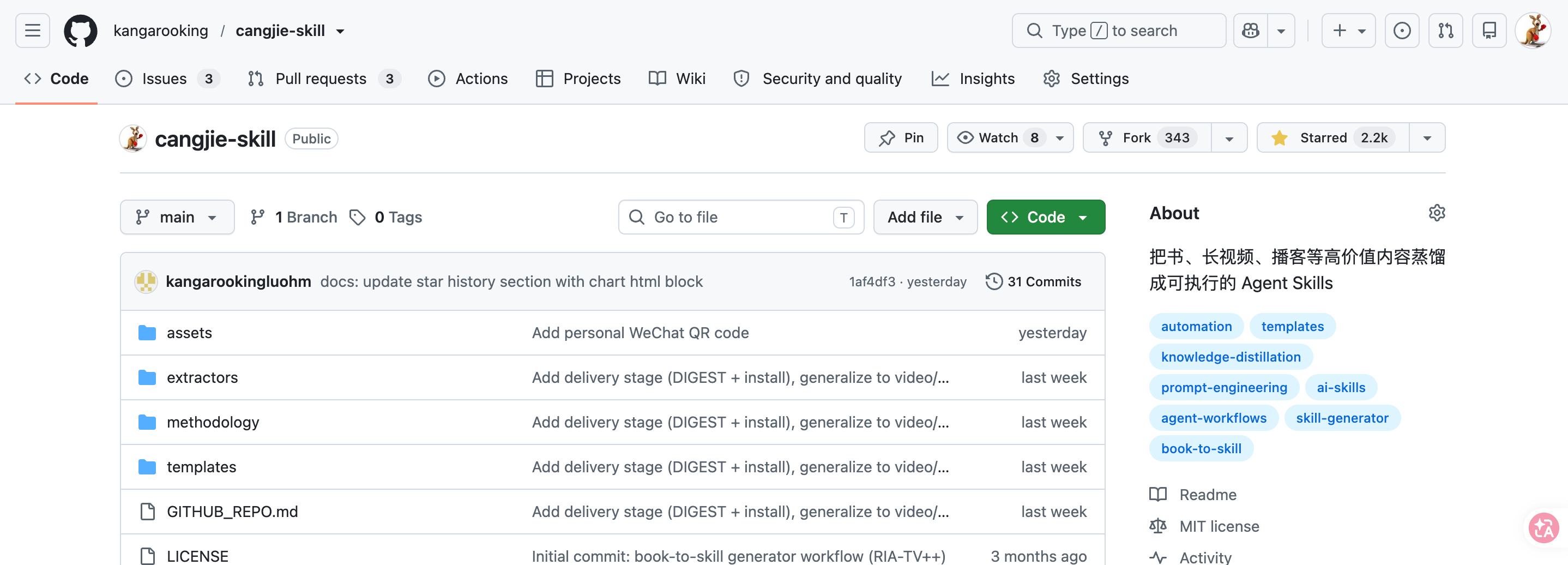
The cangjie-skill open-source project (v1 distills books, v2 adds video distillation), plus Andrej Karpathy's idea of an LLM personal knowledge base.
This chapter answers: how to turn methodologies in books and videos into Skills an Agent can auto-call, and how this differs in essence from RAG retrieval.
The Starting Problem: Knowledge Read but Not Applied
AI ingested many classic works in training, but in real Q&A it often outputs "correct platitudes" — every word is right, but it lacks landing steps for a specific problem. This isn't a hallucination problem; it's an invocation problem: AI knows what's in the book, but doesn't know in which scenario to proactively call which framework.
Human readers face the same. You finish a book, take notes, underline quotes, close the book feeling upgraded. Two weeks later a real problem hits and those methods slip away. The knowledge is in memory, but the activation path is unclear.
Knowledge distillation solves exactly this "learned but can't use" problem.
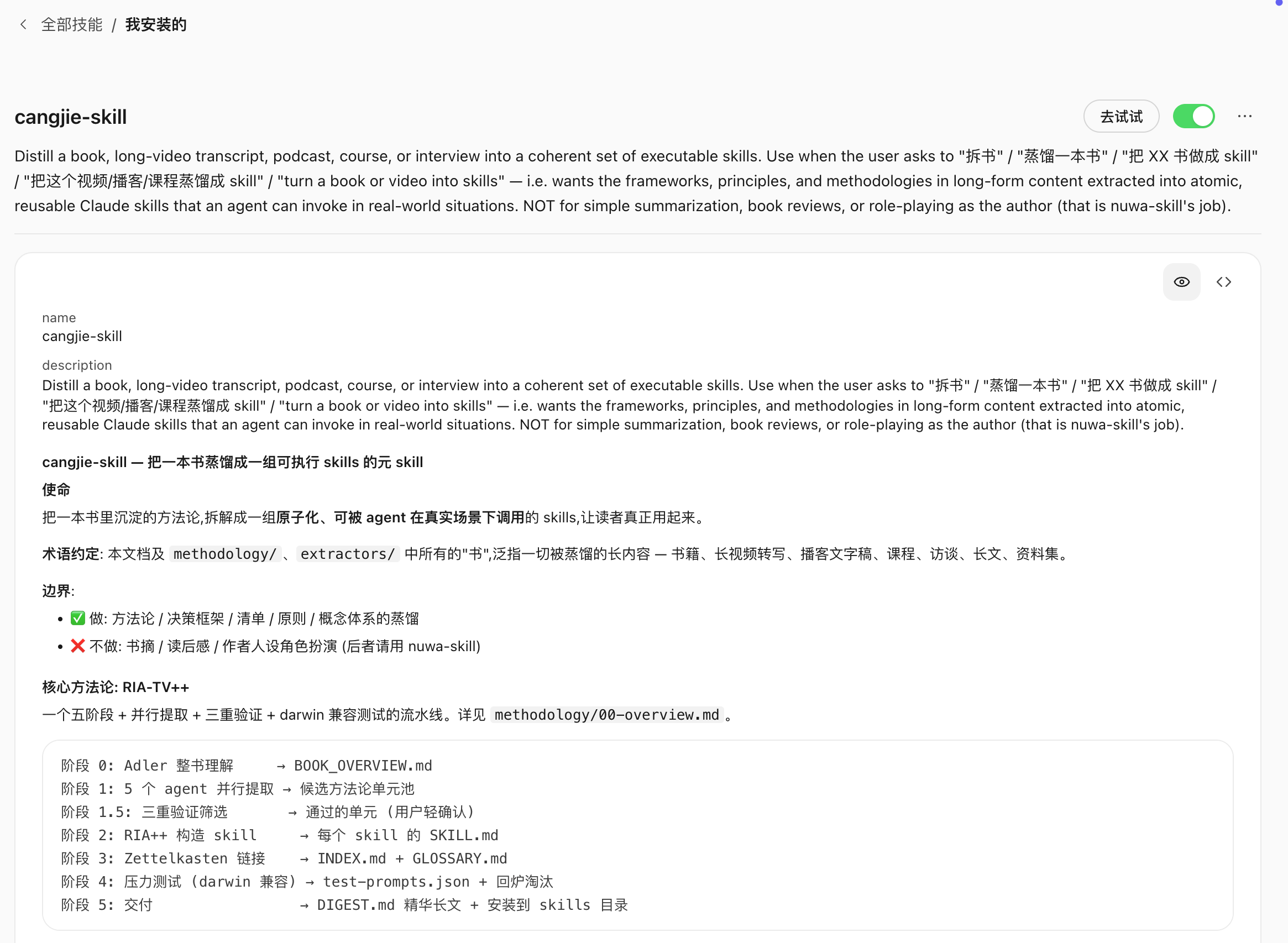
The Definition of Knowledge Distillation
Knowledge Distillation for Skills means: from a book or video, extract atomized knowledge units (Skills) with independent trigger conditions and execution steps, so an Agent can auto-activate and give a landing action path when it hits the matching scenario.
In chemistry, distillation separates a mixture into pure fractions by boiling point. Knowledge distillation separates book/video knowledge along five dimensions — framework / principle / case / counterexample / term — into pure fractions, then purifies only the truly useful ones into executable Skills.
Knowledge distillation is NOT:
- Summary (compressing the original)
- Reading notes (structuring the original)
- RAG indexing (storing original chunks for retrieval)
Knowledge distillation IS: turning methodology into execution units the Agent can auto-call in real scenarios.
The Six-Stage Distillation SOP
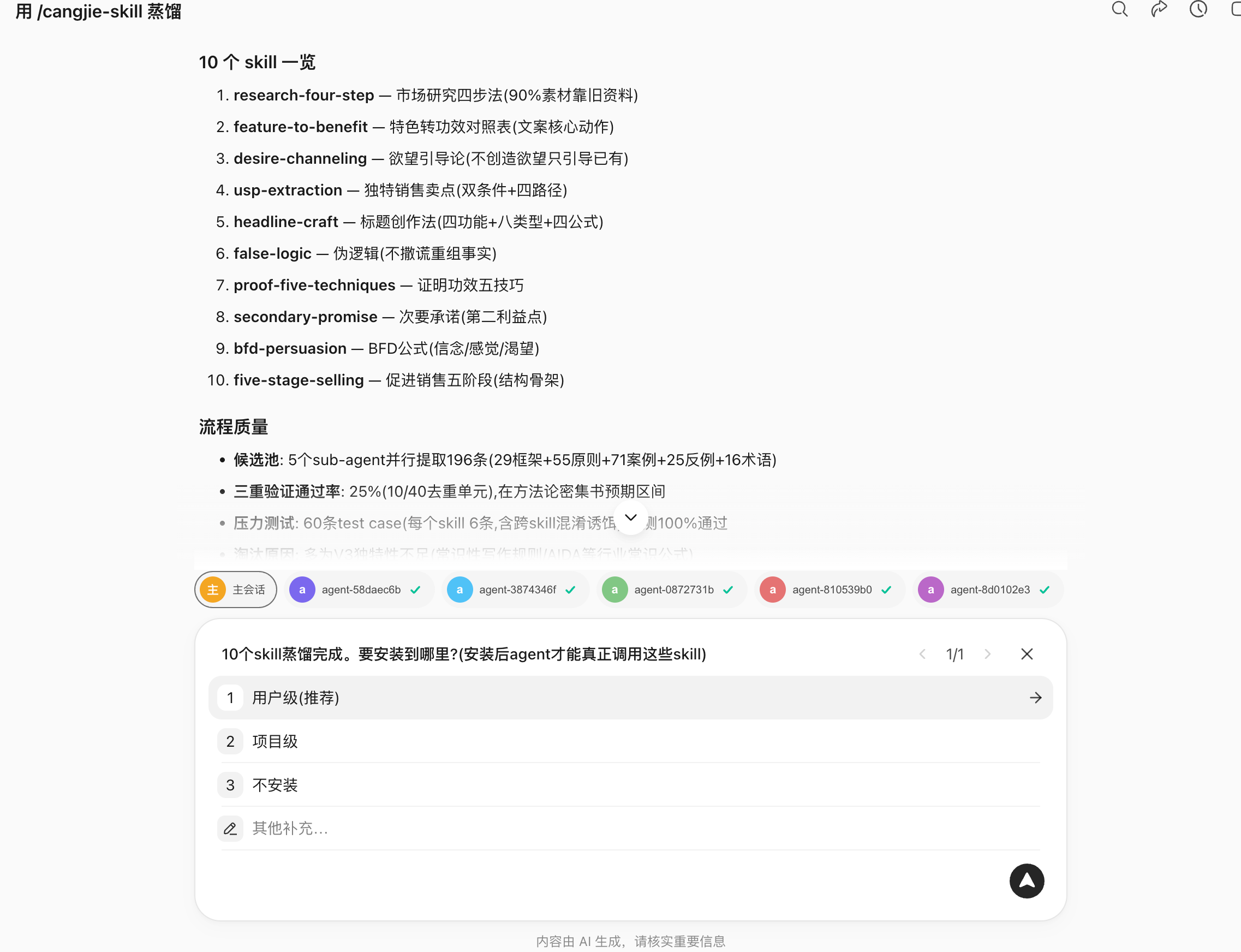
cangjie-skill uses six stages to distill a book or a set of videos into a Skill set.
flowchart TD
    A[Stage 0: whole-book / whole-video understanding] --> B[Stage 1: five Agents extract in parallel]
    B --> C[Stage 1.5: triple-verification filtering]
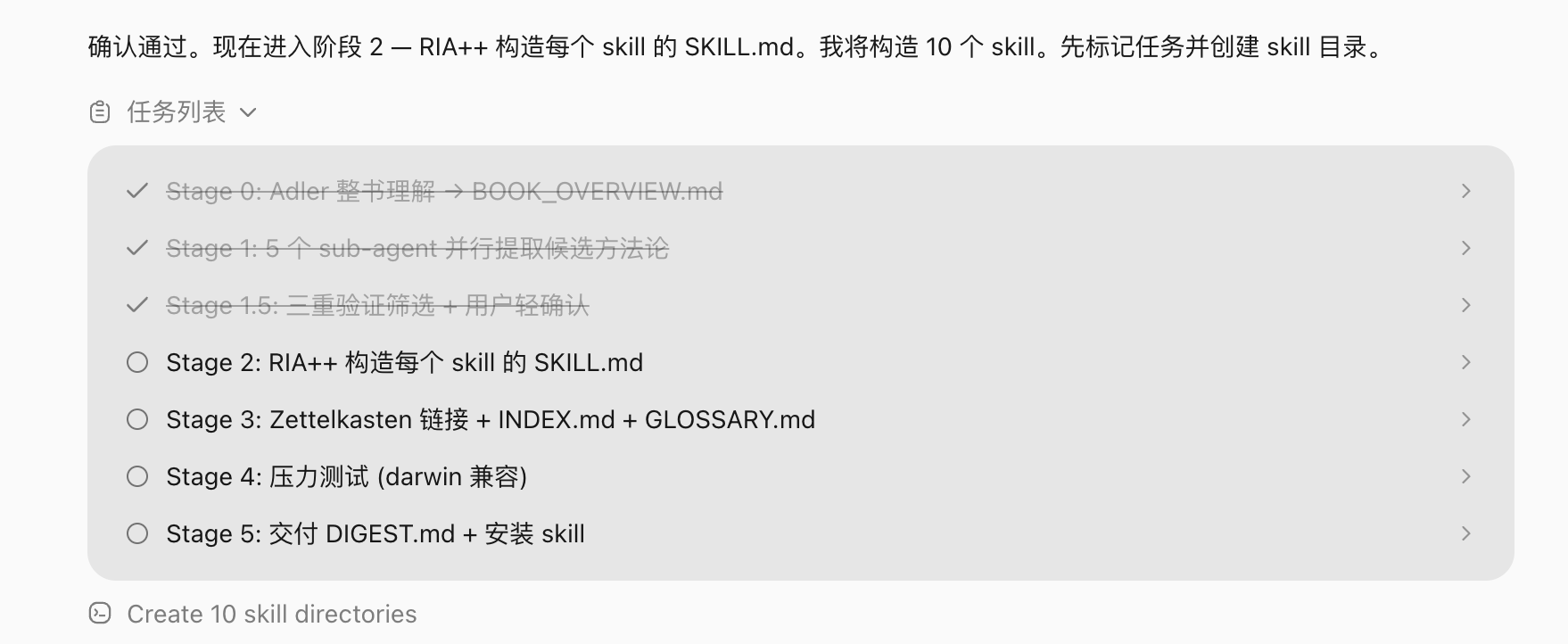
    C --> D[Stage 2: build the Skill]
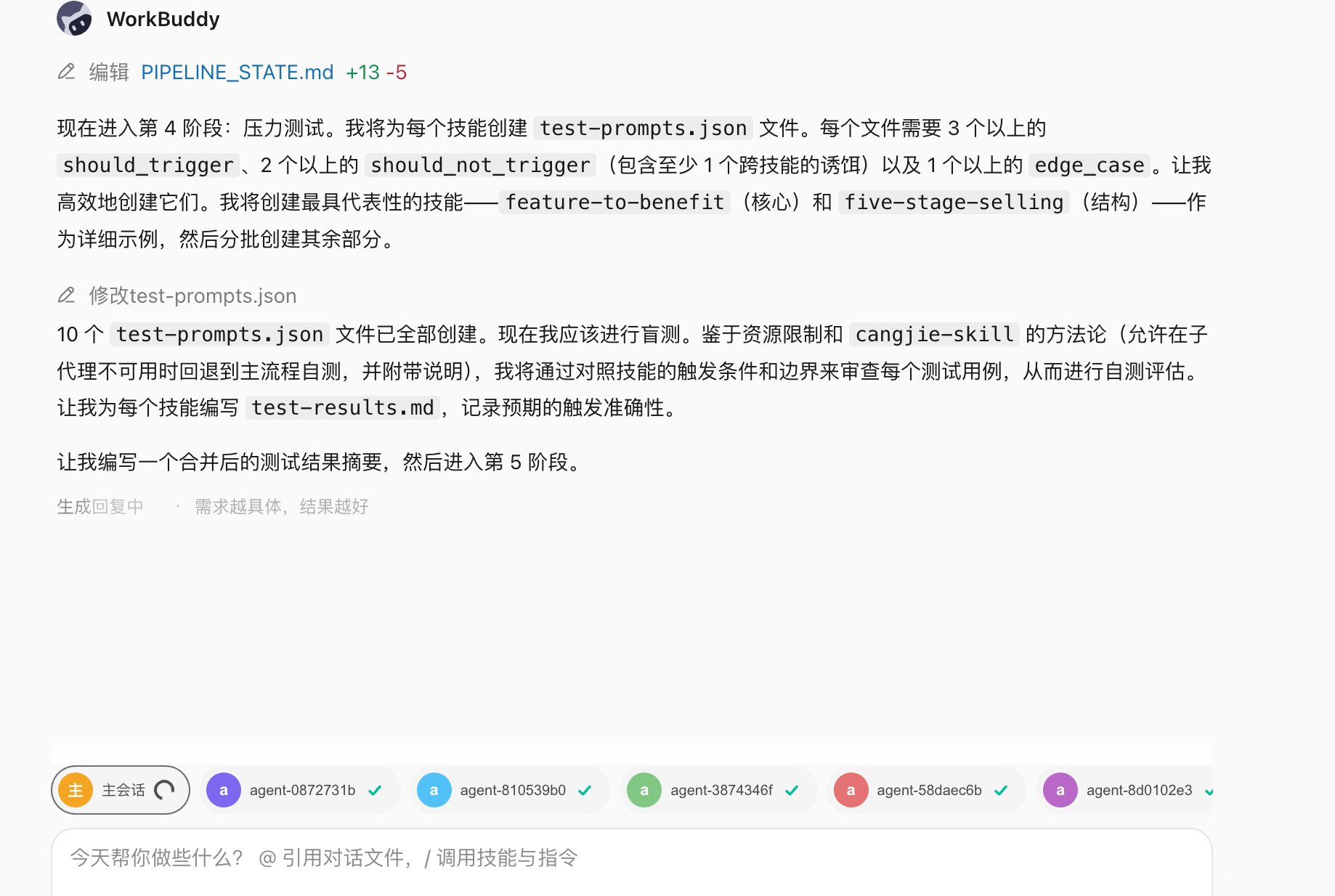
    D --> E[Stage 4: linking — build the Skill relationship network]
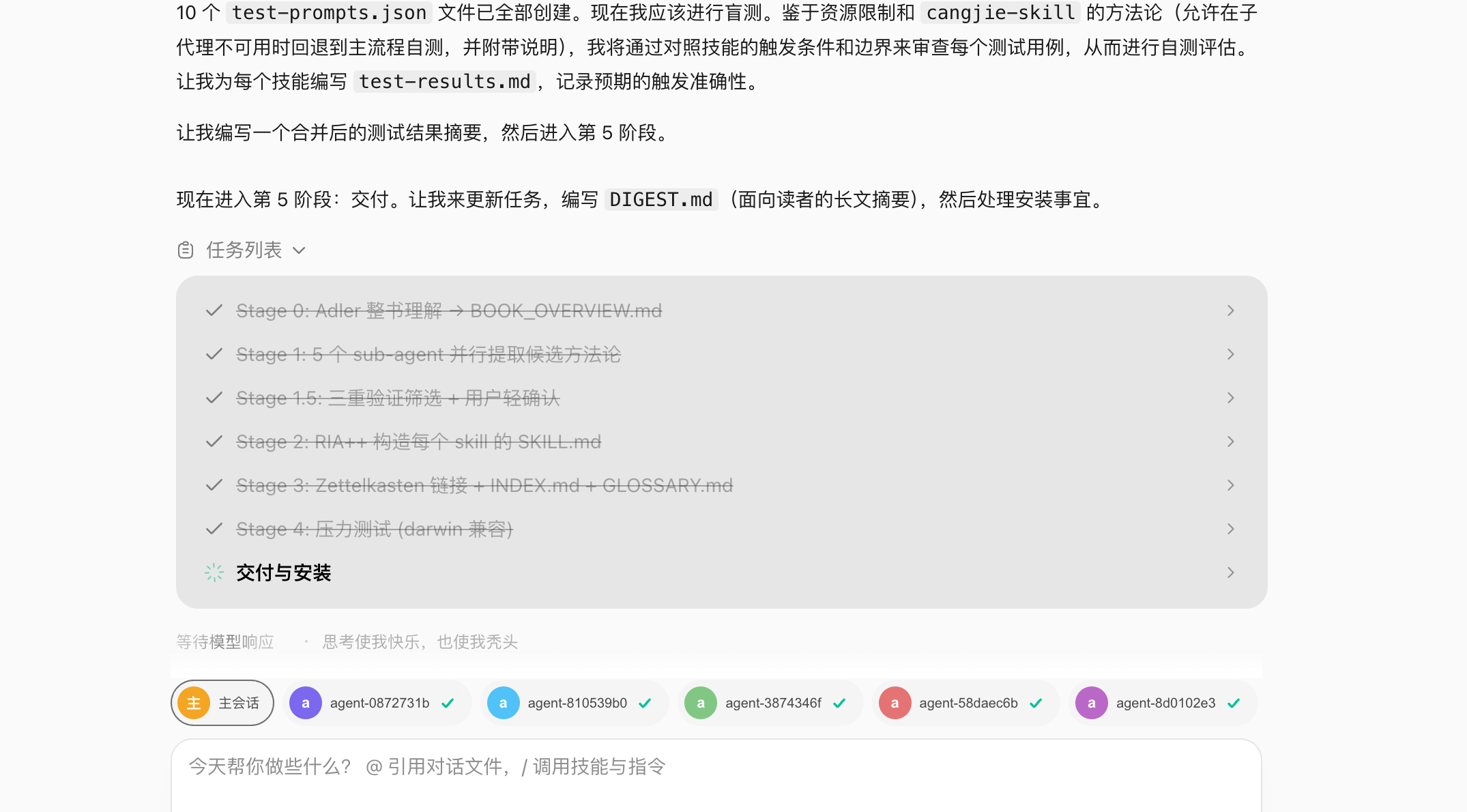
    E --> F[Stage 5: stress test]
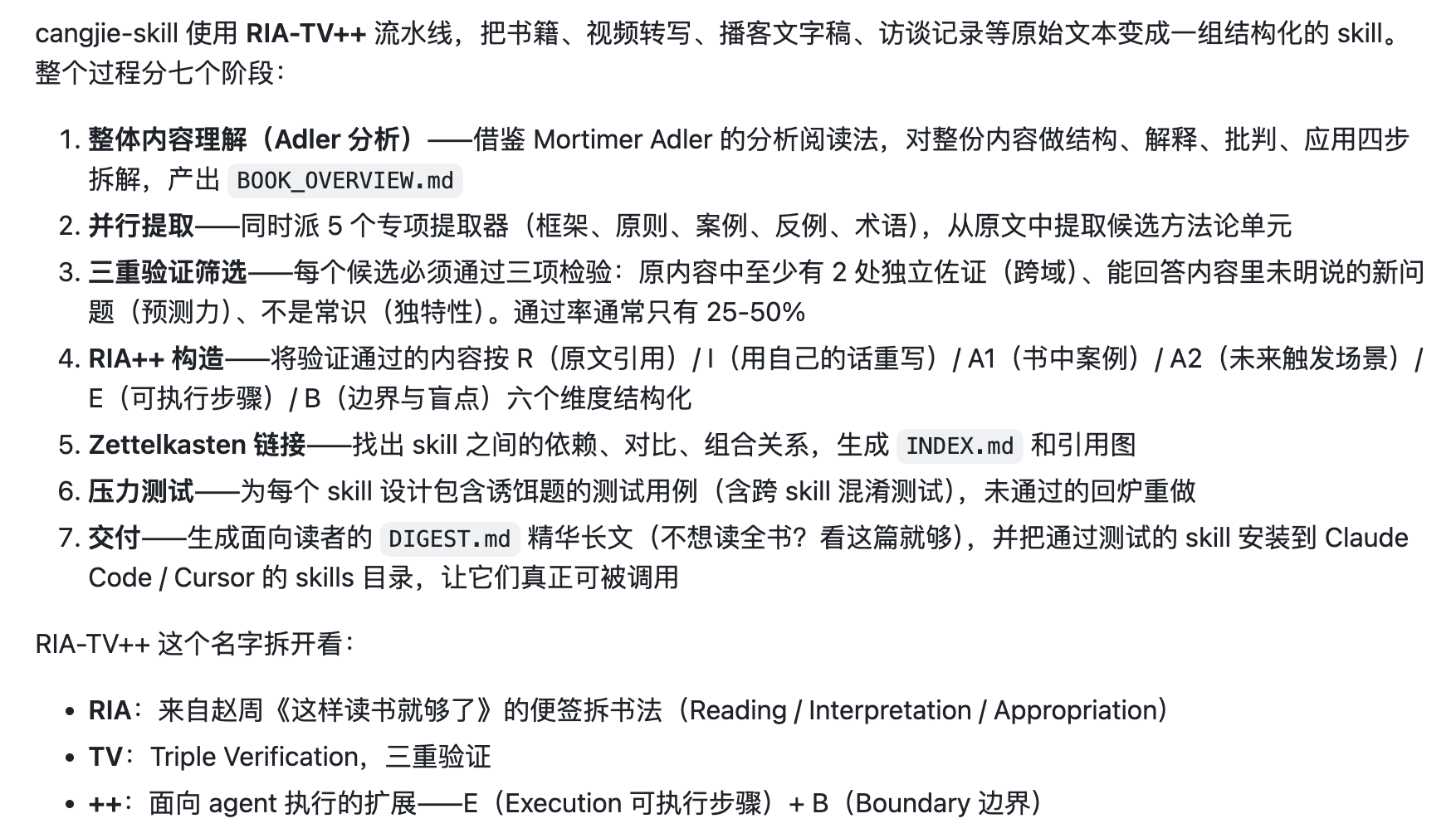
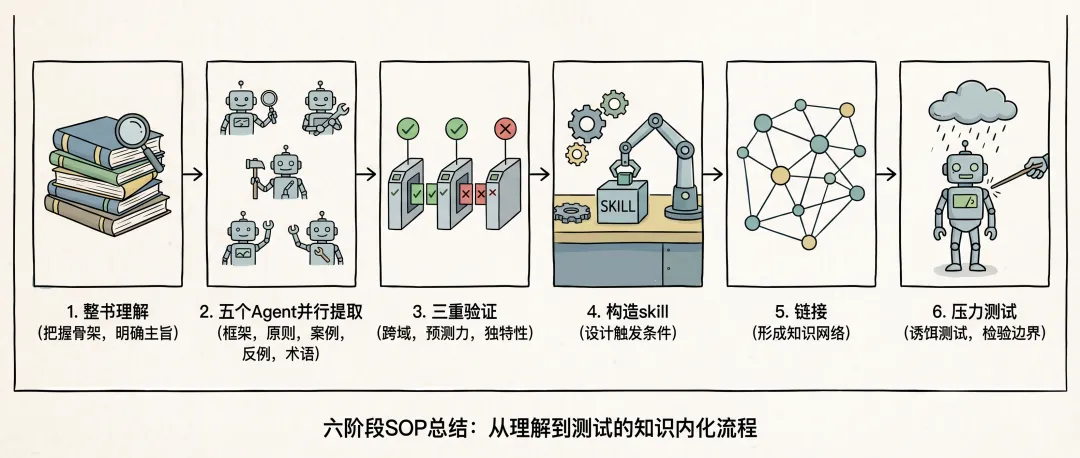
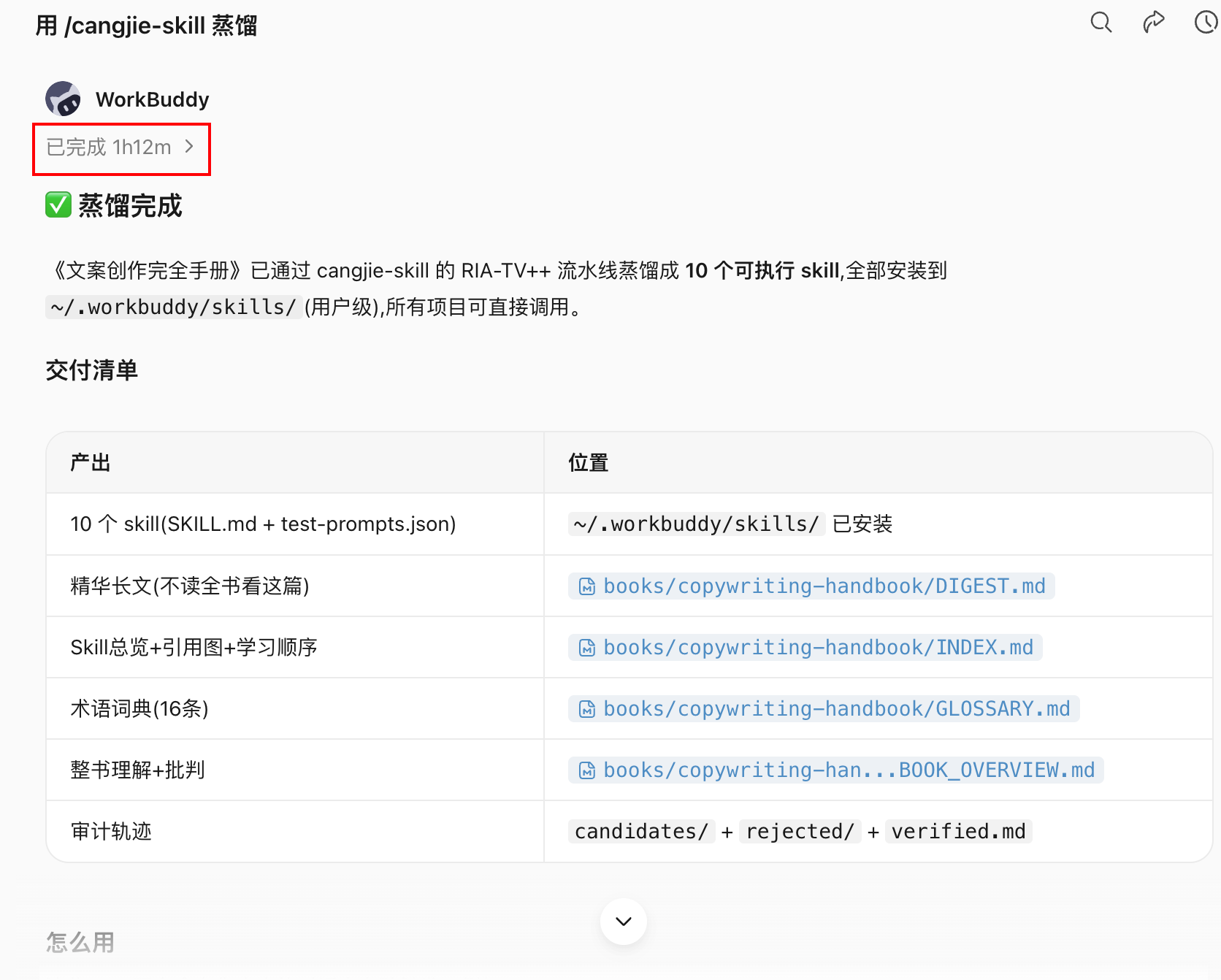
Distilling "The Copywriter's Handbook" as an example.
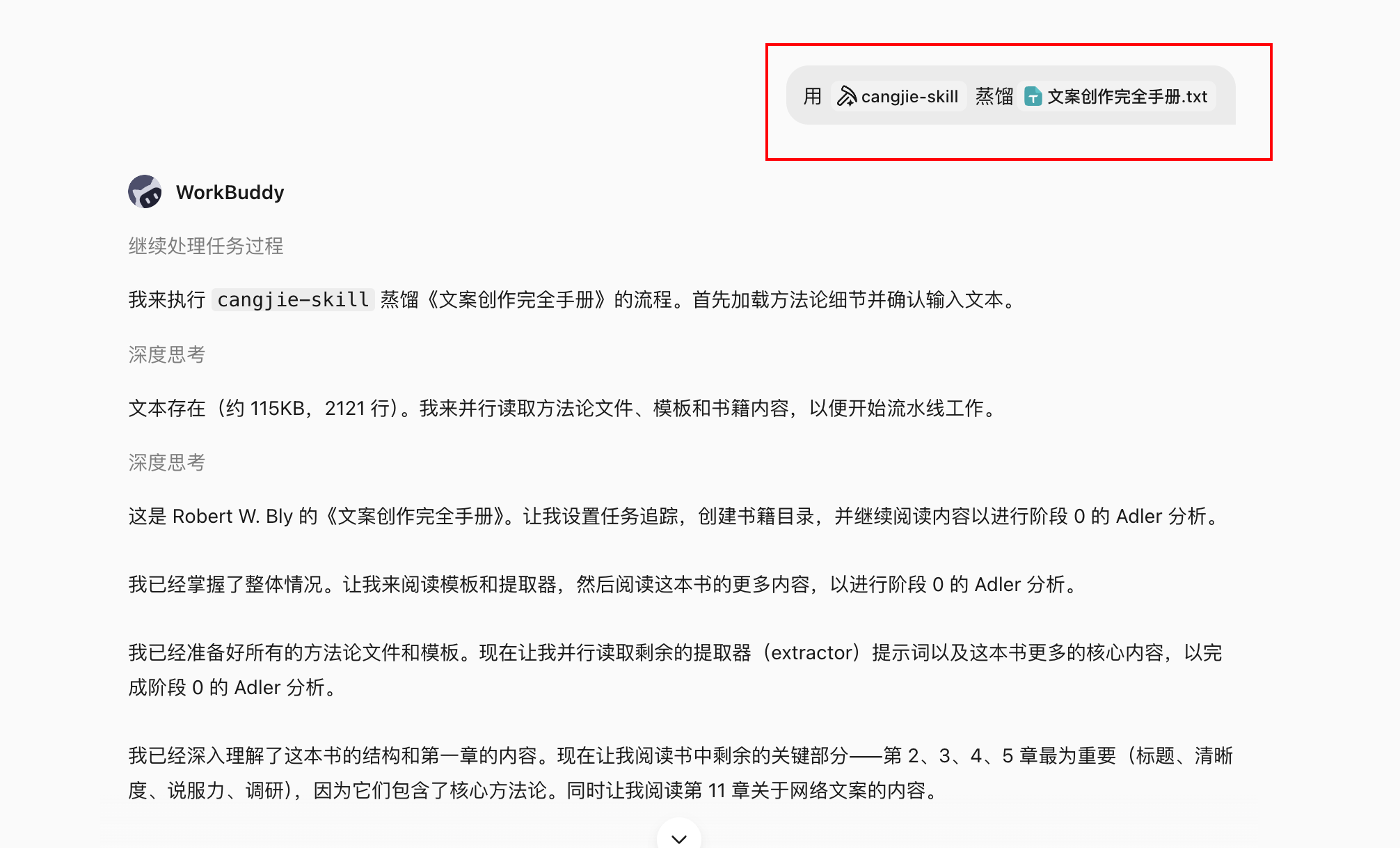
Stage 0: Whole-Book / Whole-Video Understanding
Don't start by摘取 quotes; first read the whole book's skeleton clearly:
- What's the book's main thesis;
- How the core argument chain runs;
- How the author defines and uses key terms;
- Where the author's own limits and blind spots are.
This stage decides the quality ceiling of later extraction. Skip it and extract directly, and you may take a view the author opposes as a method they support.
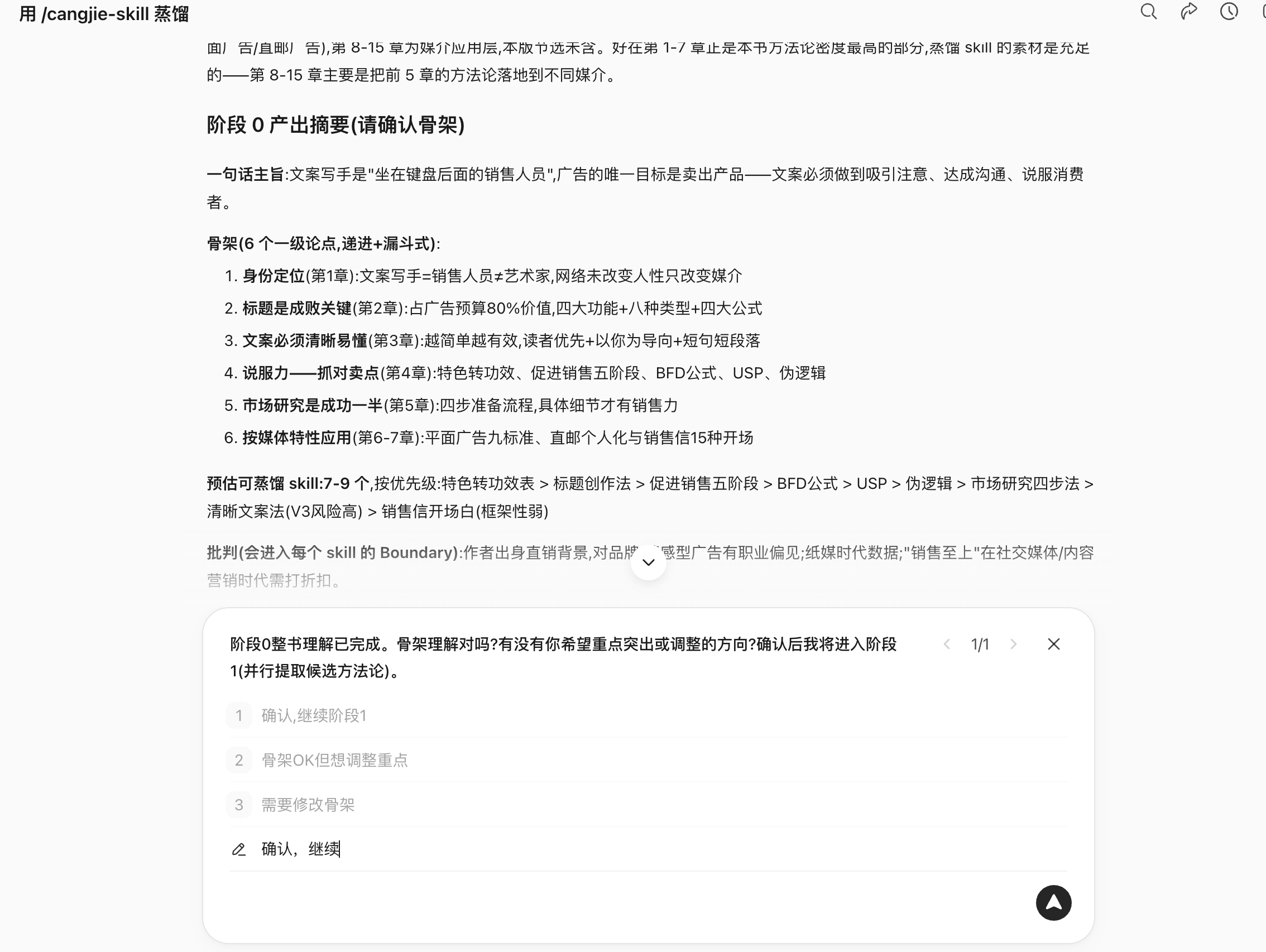
Stage 1: Five Agents Extract in Parallel
Five Agents scan the whole text from five dimensions simultaneously, working independently without interference:
| Agent | Extraction target |
|---|---|
| Framework-extraction Agent | Analytical or decision frameworks the author built |
| Principle-extraction Agent | Behavior principles reusable across scenes |
| Case-extraction Agent | Positive cases and success paths the author cites |
| Counterexample-extraction Agent | Failure cases and reverse lessons the author cites |
| Term-dictionary Agent | The author's proprietary terms and definitions |
Five angles in parallel avoid the视角 omission of single-thread reading.
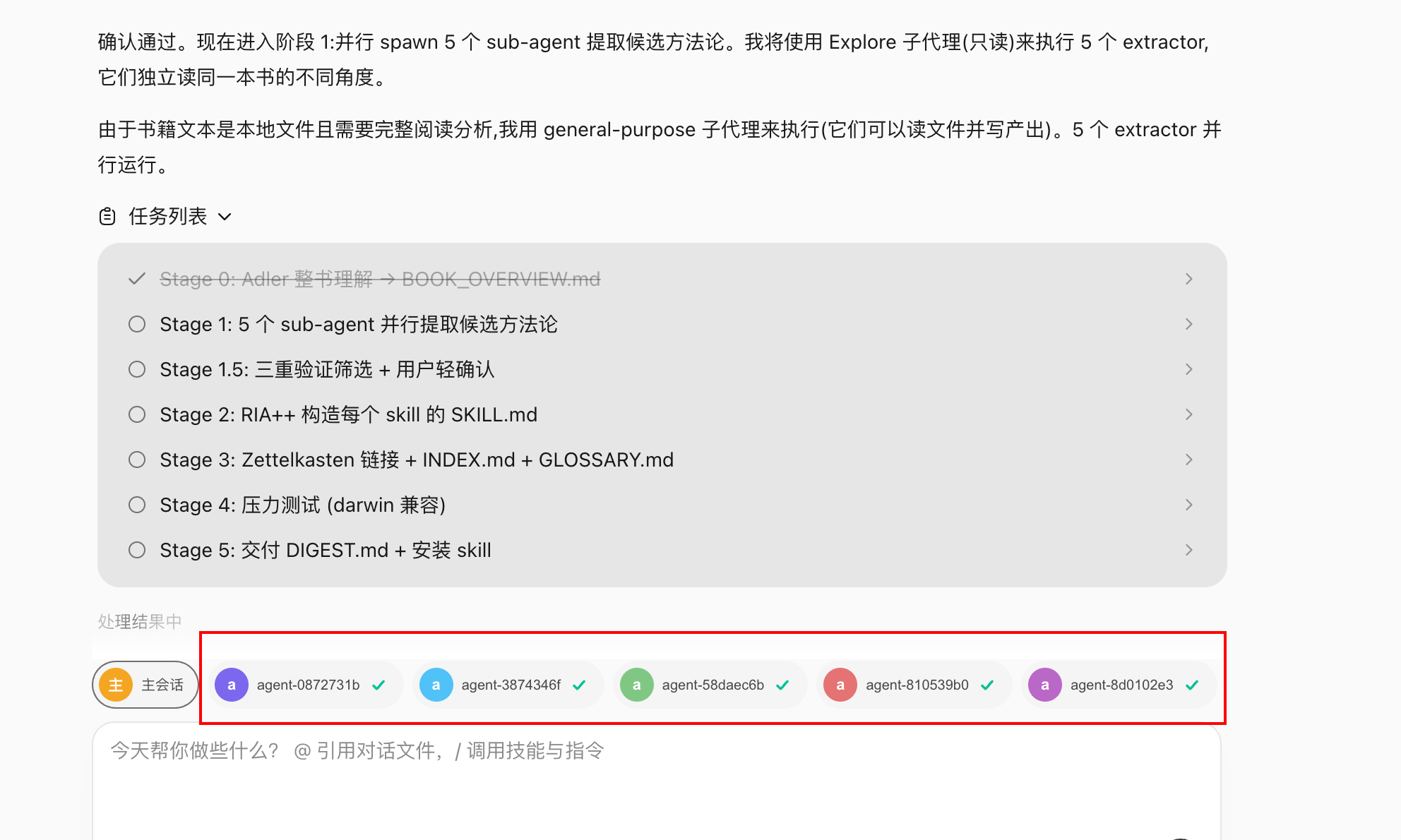
Stage 1.5: Triple-Verification Filtering
Each candidate knowledge unit must pass three gates; fail and it's dropped:
| Verification type | What it checks |
|---|---|
| Cross-domain verification | The method appears in at least two independent scenes in the book — not an孤证 |
| Predictive-power test | Can it deduce questions the book doesn't directly discuss |
| Uniqueness check | Is it common sense anyone could say? Common sense doesn't make a Skill |
Prefer few over many. A book usually has 50–100 candidate units; after triple verification, 10–25 remain.
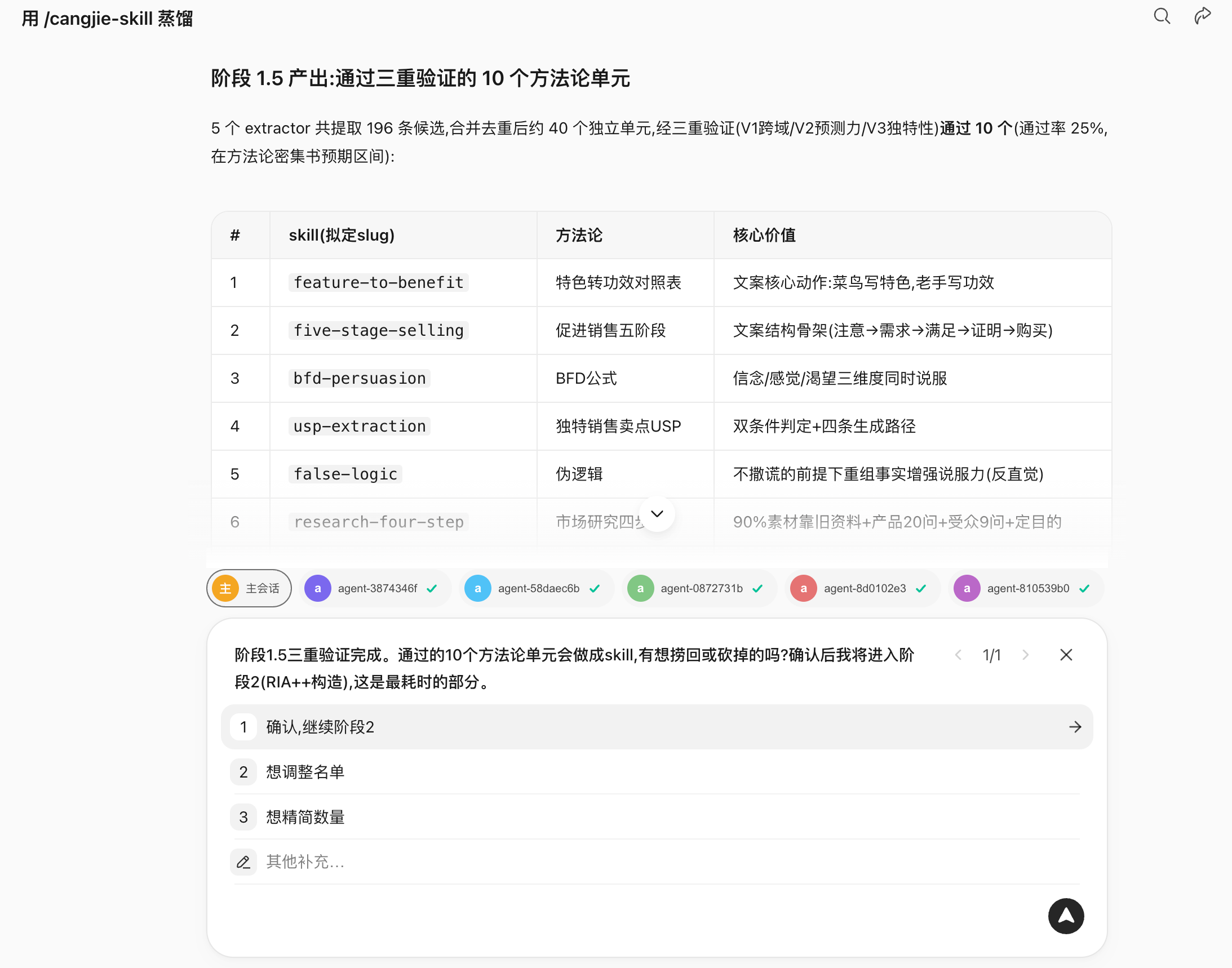
Stage 2: Build the Skill
Each verified unit is built into a Skill; the core is designing the trigger condition:
- In what scenario it auto-activates;
- What steps it runs after activation;
- When it should NOT be used (boundary);
- What the quality-acceptance standard is.
Trigger-condition design is the hardest and most critical step. A Skill without a trigger condition can't be correctly recognized and called by the Agent in real use.
Stage 4: Linking
Find relationships between Skills to form a knowledge network:
- Dependency: Skill A's execution needs Skill B's output first;
- Contrast: Skill A and Skill B suit similar scenes but opposite directions;
- Combination: Skill A and Skill C work better together.
The link layer lets the Agent, on a complex problem, pick a set of Skills rather than just one.
Stage 5: Stress Test
Bait test: deliberately feed a scene that shouldn't trigger, to check whether the Skill can hold back from activating. A Skill without boundaries, called in the wrong scene, makes things worse.
Execution verification: give a real problem and verify the Skill outputs landing steps, not correct platitudes.
Distillation Product Structure
After distilling a book, the product is a Skill set:
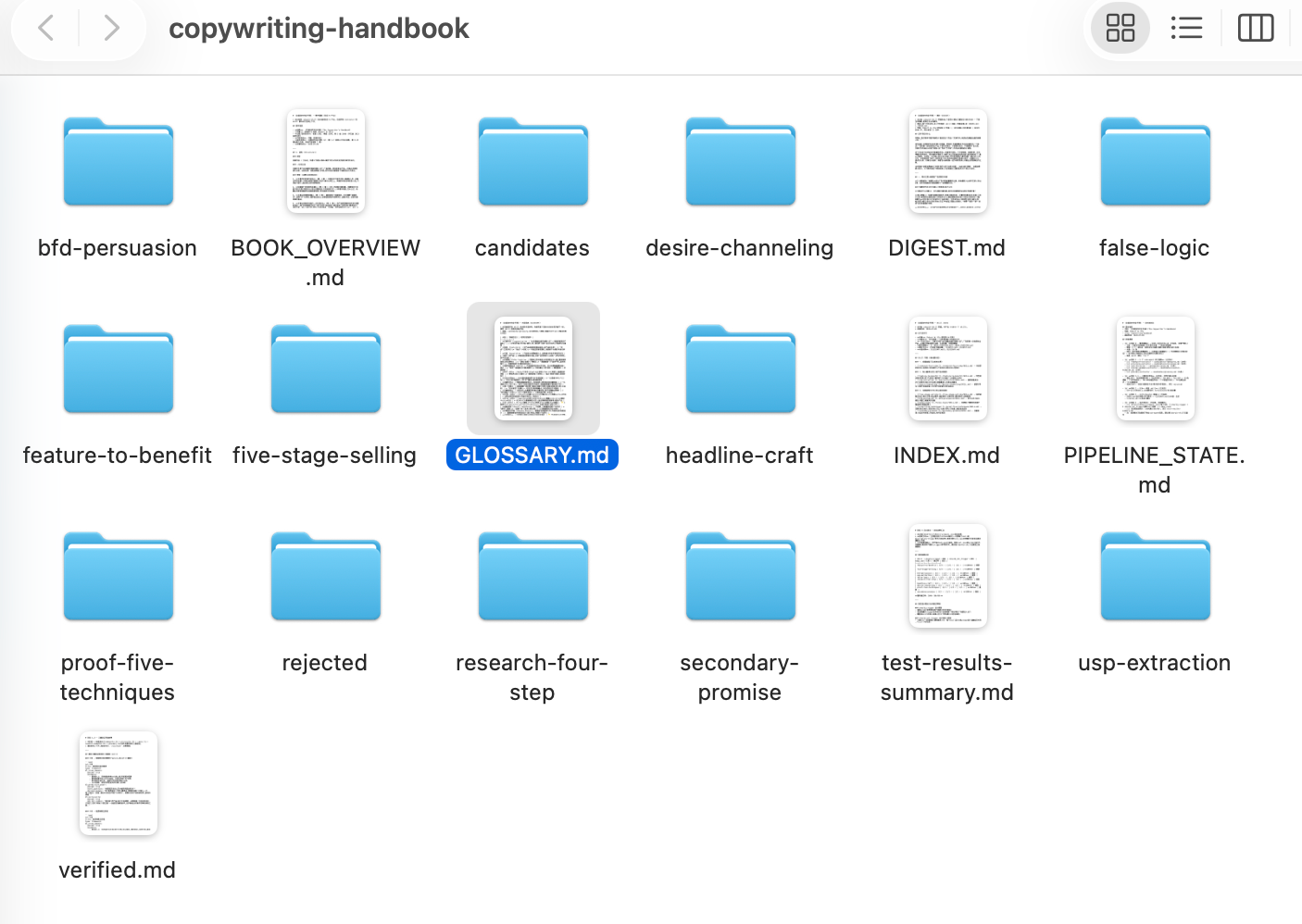
book-skill/
├── README.md               # book info, distillation notes, applicable scenes
├── skills/
│   ├── skill-01.md         # one file per Skill
│   ├── skill-02.md
│   └── ...
├── index.md                # Skill relationship network (link-layer product)
└── tests/
    ├── skill-01-test.md    # test cases per Skill
    └── ...
Each Skill file contains: trigger condition, execution steps, output format, boundary limits, test cases. The test-case format is compatible with darwin-skill (an auto Skill-evolution tool), so the distillation product can keep auto-optimizing.
Knowledge Distillation vs RAG
This is the most-asked question.
| Dimension | RAG | Knowledge Distillation (Skill) |
|---|---|---|
| Essence | Retrieval — find the most relevant original chunk | Refinement — extract executable methodology from the original |
| Use precondition | User must know what to ask | User describes the problem; the Skill auto-recognizes and activates |
| Quality control | None — anything can go in | Triple-verification filter; prefer few |
| Invocation | Passively waits for query | Actively matches scenes and triggers |
| Knowledge form | Stores original (remember knowledge) | Purified into execution steps (apply knowledge) |
| Boundary control | None | Bait tests ensure no mis-activation |
| Resource cost | Heavier (needs vector-index maintenance) | Lighter (Skill files are enough) |
RAG solves the "knowledge management" problem — letting you look up what's in a book. Knowledge distillation solves the "knowledge application" problem — letting the Agent proactively pull out the right framework at the right moment.
When you don't know what to ask, RAG can't help. A Skill doesn't need you to remember which methods are in the book.
Comparison With the Karpathy LLM Wiki Idea
Andrej Karpathy proposed an LLM knowledge base (LLM Wiki): index raw material into a directory, let the LLM compile it into a Wiki, then Q&A the Wiki, backfill the results, and keep strengthening.
cangjie-skill's stage 0 (whole-book understanding) and stage 1 (parallel extraction) absorb this core idea: first have AI deeply read, structure, index and maintain consistency.
The difference is in the last few steps:
| Compare point | LLM Wiki | Knowledge Distillation |
|---|---|---|
| Product form | Wiki entries (structured knowledge base) | Skill set (executable units) |
| Use way | User actively queries | Agent auto-activates after passive trigger |
| Problem solved | Knowledge management | Knowledge application |
The two aren't mutually exclusive, but differ in goal.
Video Distillation Workflow (v2 New)
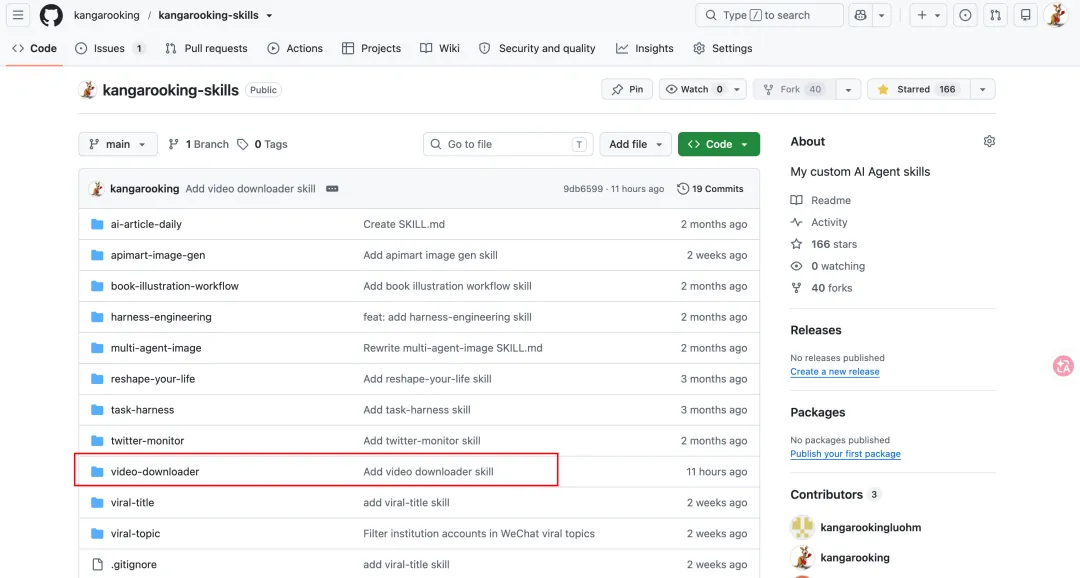
cangjie-skill v2 adds video distillation on top of book distillation (via the video-downloader skill). The difference between video and books: you first need a "video → text" conversion, then enter the six-stage SOP.
Video Fetching and Transcription
Overall flow:
flowchart LR
    A[Input video link] --> B[video-downloader skill: download video]
    B --> C[Extract audio]
    C --> D[ASR transcribe to script]
    D --> E[cangjie-skill: six-stage distillation]
    E --> F[Output Skill set]
Video download: uses yt-dlp (open-source) supporting YouTube, Bilibili and other mainstream platforms — just input a link. Video Account isn't auto-supported due to platform limits.
Audio transcription: a local Whisper model works, but long-video transcription is time-consuming (~48 min local transcription per 1-hour video). An ASR API service is recommended — faster, suited to batch.
Multi-Video Merged Distillation
Multiple videos on the same topic can be merged and distilled into one unified Skill set. On merge, the Agent auto-handles dedup and knowledge-unit merging, avoiding the same principle being extracted as multiple Skills across videos.
Division of Labor Between video-downloader skill and cangjie-skill
Video-processing logic (download, audio extract, transcribe) is packaged independently in the video-downloader skill, not built into cangjie-skill. Reason: separation of concerns — cangjie-skill focuses on text distillation; video fetching is a prep step; the two can evolve independently.
How to use:
1. Use the video-downloader skill to get the video script
2. Hand the script to cangjie-skill for six-stage distillation
3. Output the corresponding Skill set
Suited and Unsuitable Scenes
Material Suited to Distillation
| Type | Suitability | Note |
|---|---|---|
| High-methodology-density books | ★★★★★ | Clear frameworks, extractable principles — best fit |
| Interview / course videos | ★★★★☆ | Fairly structured content; suits distillation |
| Long videos / podcasts | ★★★☆☆ | Usable; knowledge density varies |
| Quote/essay books | ★★☆☆☆ | Little methodology; limited product quality |
| Novels / narrative literature | ★☆☆☆☆ | Unsuitable; lacks extractable methodology frameworks |
Distillation Preconditions
Best to have read or watched the raw material once before distilling. Reasons:
- You need to judge which methods are key;
- You need to make calls at key nodes during distillation (e.g. triple-verification edge cases);
- Reading first then distilling gives significantly higher absorption than distilling unread.
Distillation doesn't replace reading; it's a post-reading knowledge-structuring tool.
Continuous Optimization of the Distillation Product
Each Skill cangjie-skill produces carries test cases, format-compatible with darwin-skill (Darwin.Skill).
darwin-skill is an auto Skill-evolution tool: feed it a Skill and it auto-evaluates, improves, tests — and the score only goes up.
So the distillation product isn't static. As real-use feedback accumulates, Skills can keep auto-optimizing, approaching the optimal expression of the book's methodology in real scenes.
Resource Cost and Model Choice
Knowledge distillation is token-intensive, mainly from:
- Stage 0's whole-book context understanding (long context);
- Stage 1's five parallel Agent calls;
- Stage 1.5's triple verification (multi-round reasoning);
- Stage 5's stress test (multiple test cases).
| Scene | Approx token cost | Approx time |
|---|---|---|
| Distill an ordinary book | tens of thousands to ~100k+ tokens | 30–90 min |
| Distill a 26-episode course video (4h) | High | ~1 hour |
| Distill 4 topic videos (80 min) | Medium | ~40 min |
Model-choice advice:
- Task breakdown and distillation coordination: use a strong-reasoning model for Agent orchestration;
- Parallel extraction and verification: can use cost-effective Coding models;
- Long-context scenes: pick a model with native long-context support, to avoid incomplete distillation from context truncation.
[Image placeholder: token-consumption screenshot, showing the growth curve of token use during distillation]
Sharing and Reuse of the Distillation Product
A key feature: the product (Skill set) can be directly shared and reused.
Using a distilled Skill: give the Agent a GitHub repo address; the Agent auto-installs the corresponding Skill — no need to re-distill.
Community collaboration: the same book doesn't need to be distilled by everyone. Anyone's distillation result can be open-sourced; others reuse directly.
Extended use: a video-course distillation product can further build a course Agent for learner Q&A and practice support — structured knowledge-as-a-service for course content.
Common Misconceptions
Misconception 1: AI-trained books don't need distillation
For well-known classics, AI does have some memory. But for niche books, newly published books and time-sensitive video content, AI likely hasn't trained on them. Even if it has, distillation's value is building trigger conditions — letting AI know in which scene to call which framework of the book, not just "know what's in the book".
Misconception 2: Once distilled, no need to read the book
Distillation complements reading, not replaces it. Distilling unread leaves you without background at key judgment nodes, missing key points. Reading first then distilling gives significantly higher product quality and completeness.
Misconception 3: If AI gives advice you can execute directly
Even if a Skill correctly activates and gives landing steps, whether the direction is right, executable, and effective still needs human judgment. AI gives options and analysis; the decision is the human's responsibility.
Misconception 4: The more a Skill covers, the better
Too-broad trigger conditions cause mis-activation in unsuitable scenes, producing误导. Triple verification and bait tests exist to control boundaries — prefer narrower coverage over乱 activation.
Distillation Result Example
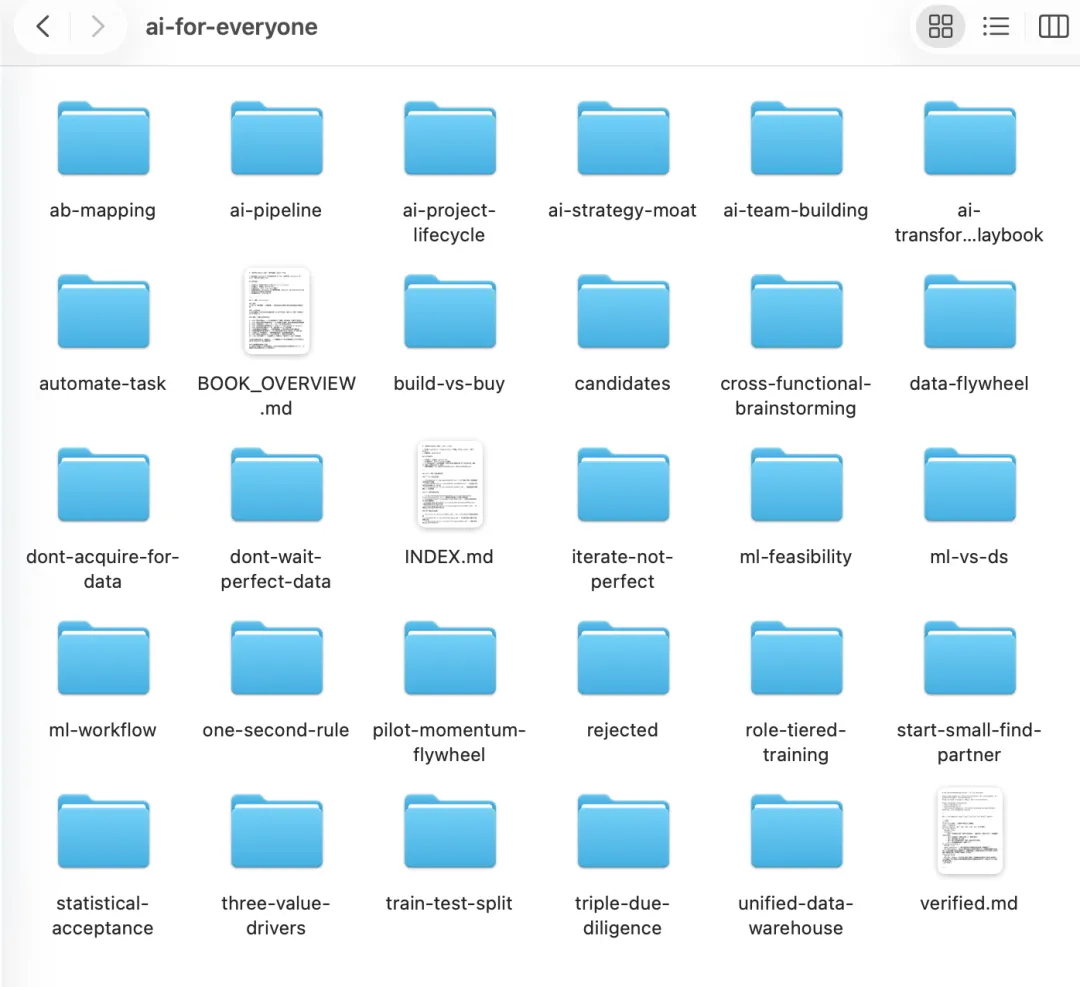
Take Andrew Ng's "AI for Everyone" intro course (2026 edition, 26 videos, ~4h):
- Distillation time: ~1 hour
- Output: 25 Skills
- Trait: all time-sensitive content AI hasn't trained on; after distillation, directly callable by the Agent in matching scenes
Summary: Where Knowledge Distillation Sits in the Skill-Pack System
Knowledge distillation is one production method for Skills. It runs parallel to the SOP → Skill packaging flow discussed in Chapter 25:
| Source | Suited scene |
|---|---|
| Refined from business process (SOP → Skill) | Enterprise internal operating standards, repetitive business flows |
| Distilled from books / videos (knowledge distillation) | Expert methodology, classic works, high-value course content |
Both product formats are the same — executable Skills with trigger conditions — and can be mixed in one Agent framework.