Chapter 14 — The Value of a Life Assistant Is Reducing Friction
Life Problems Are Vaguer Than Office Problems
"Plan my trip", "read my health report", "what to eat today", "do my fortune" — each looks like one sentence, but mixes preferences, real-time data, privacy and risk. Office files done wrong can be redone; medical, payment, visa and big-decision mistakes can cost something else entirely.
So first split life scenes into three types:
| Type | What WorkBuddy can do | What the human must do |
|---|---|---|
| Info-organizing | Collect preferences, compare candidates, generate lists | Confirm facts and the final choice |
| Real-time decision | Query weather, routes, stock, rules; mark the time | Verify on official or vendor pages and act there |
| High-risk or entertainment | Tidy medical questions, give entertainment readings | Leave medicine to professionals; don't use fortune as a decision basis |
Scene 1: A Three-Day Trip Without Opening Twenty Apps
Guides, maps, weather, hotels, transit, budget and travel-companion preferences live in different apps. A plain AI itinerary looks complete but may put far-apart spots together, cite stale opening hours, or even invent restaurants.
- Travel Assistant: itinerary, destinations, lodging, food and packing list;
- Tencent Map Assistant: POIs, routes, distance, weather and maps;
- Smart Packing List: packing list by weather, days and group;
- Tour Weather Risk: add when fine-grained weather risk is needed.
Step 1: Collect Constraints First
Don't lay out the itinerary yet. Collect travel constraints in no more than 8 questions:
origin, dates, companions, budget, transit preference, daily walk cap, interests,
dietary restrictions, must-go and must-avoid spots.
Don't re-ask info already provided.
Step 2: Candidate Routes and Real-Time Verification
Plan a 3-day free trip from Shanghai to Quanzhou, July 18–20, for 2 adults.
Budget 5000 RMB; prefer culture and local snacks; under 15000 steps a day.
Give two route directions first and explain the trade-off; I'll confirm before you generate the day-by-day plan.

Use map capability to verify spot order, distance and estimated transit time;
mark ticket price, opening hours, reservation, weather and transit schedules with query time and source.
For anything that can't be verified in real time, write "TBD" — don't fabricate.
Output rain alternatives, a budget range and a packing list.
Don't log in, book, pay, or accept refund/change terms on my behalf.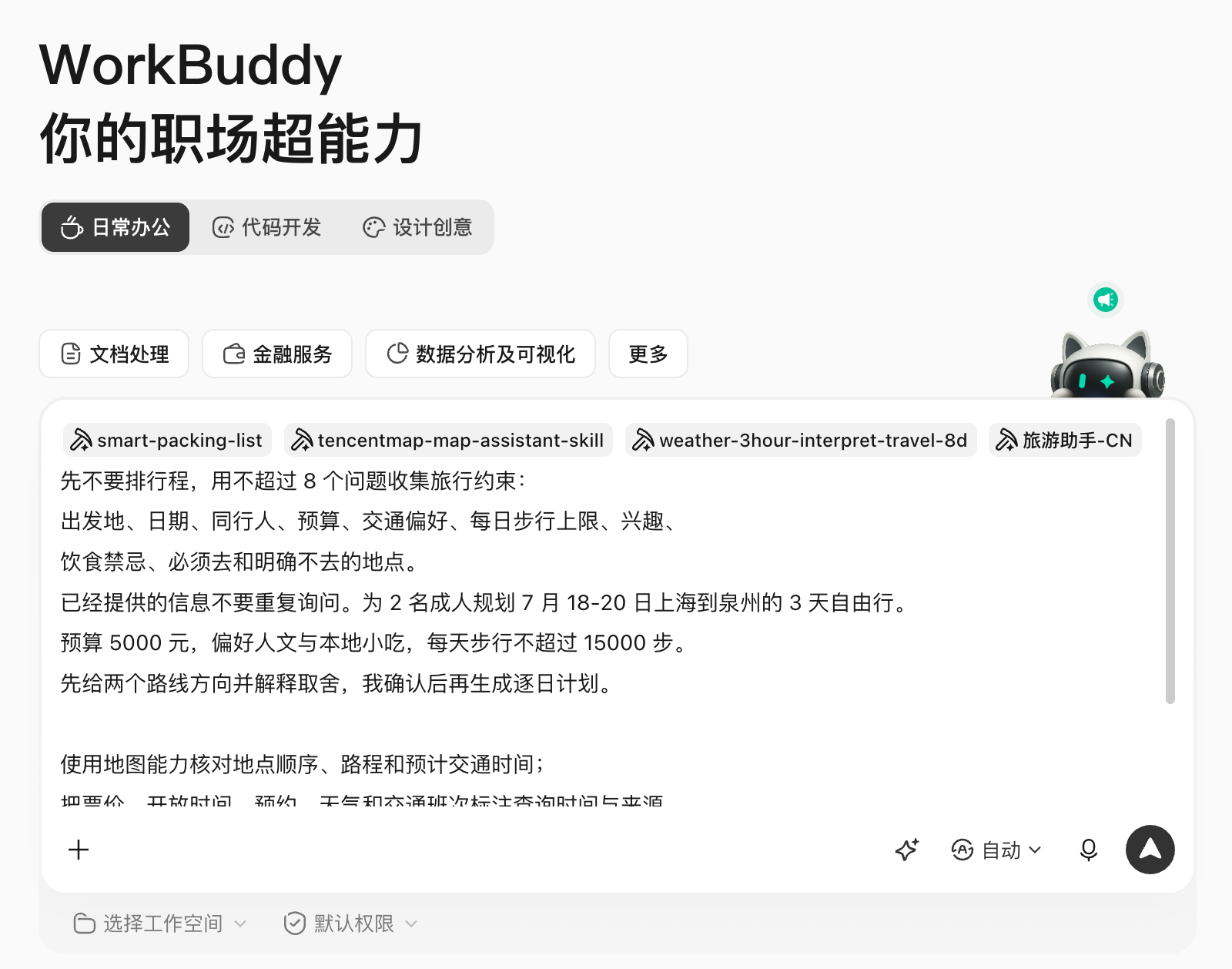
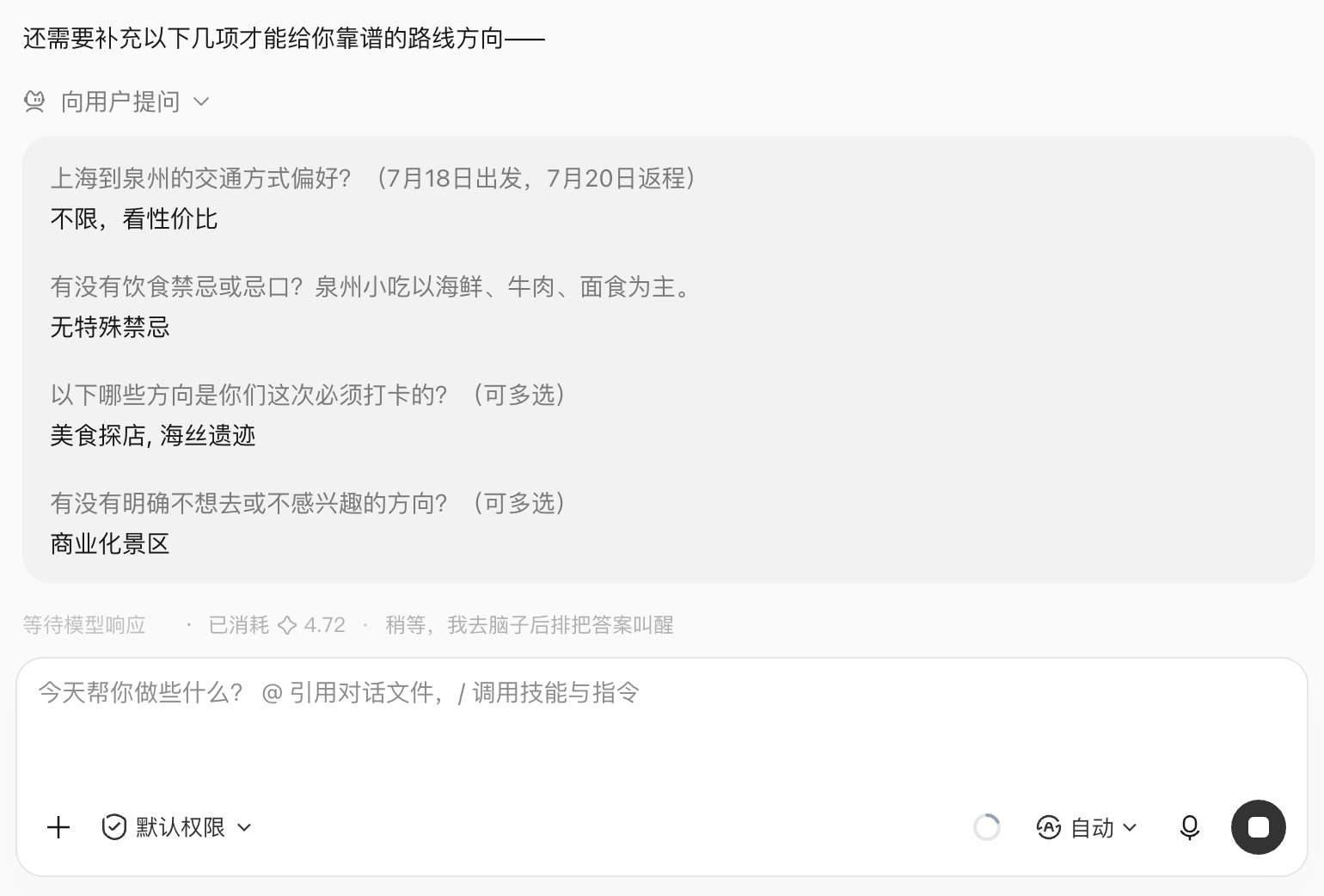
During execution WorkBuddy doesn't just make decisions for you — it asks as many questions as needed, acting like a dedicated guide planning your trip.
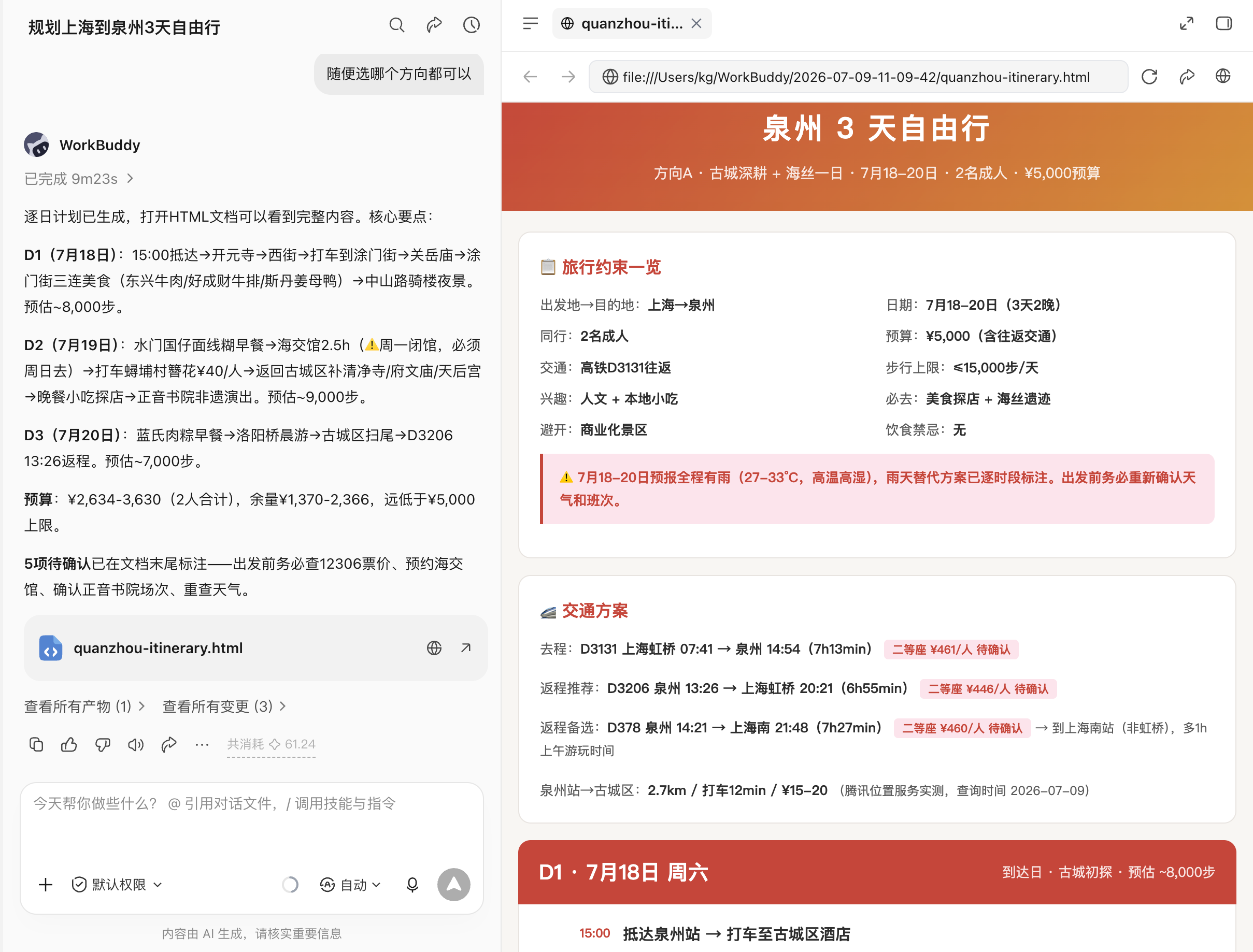
Execution Chain and Deliverables
Preference survey → two route drafts → human picks direction → map optimization → weather & open-hours verification → budget & packing → a shareable itinerary page. A genuinely usable deliverable includes a map itinerary, sensible sightseeing and transit timing, data sources and real schedules — not just a pretty schedule.
Before booking, the human re-confirms stock, price, visa, documents, insurance and refund policy. When it involves elderly, children, pregnant, chronic-illness or accessibility needs, write the limits explicitly into the task — don't let the model infer.
Scene 2: After the Trip, Turn Photos and Receipts Into Reusable Records
WorkBuddy can also, after the trip, organize photos by date and spot, sort receipts, review the budget and draft a guide — but don't default to reading the whole album or deleting originals.
Only read the photos and receipt copies in trip-quanzhou/import.
Generate a daily timeline by shooting time; list failed-recognition files for human confirmation.
Sort receipts by transport, lodging, dining, tickets; sum amounts and compare to budget.
From the spots and feelings I confirm, generate a private travel record.
In the public version, desensitize people photos, locations and order numbers entirely.
Don't move or delete originals.
This scene can feed back into the self-media chapter: after the private record is confirmed, choose what suits a Xiaohongshu guide or a WeChat long-form post.
Scene 3: Can't Read the Health Report — Prepare a More Effective Doctor Visit
Health-checkup indicators and symptom notes are many; users easily self-diagnose after web searching; some health Skills even claim to give disease probabilities. This field guide doesn't take that approach.
- Health Coach Pro: emphasizes lifestyle, checkup-data understanding and visit prep — no diagnosis, no prescriptions;
- Tencent Health-related clinical Skills should only be used when qualifications, authorization and an actual medical workflow exist; ordinary users can't treat output as a diagnostic conclusion;
- Medication-safety questions should go to a doctor or pharmacist first — don't let a general Agent decide stopping, switching or dosing.
The WHO stresses putting ethics, human rights and accountability at the center of AI-for-health design and use. For an individual, the most practical boundary: AI helps organize information and prepare questions, not replace clinical judgment. Ref: WHO "Ethics and governance of artificial intelligence for health"
Safety Instruction
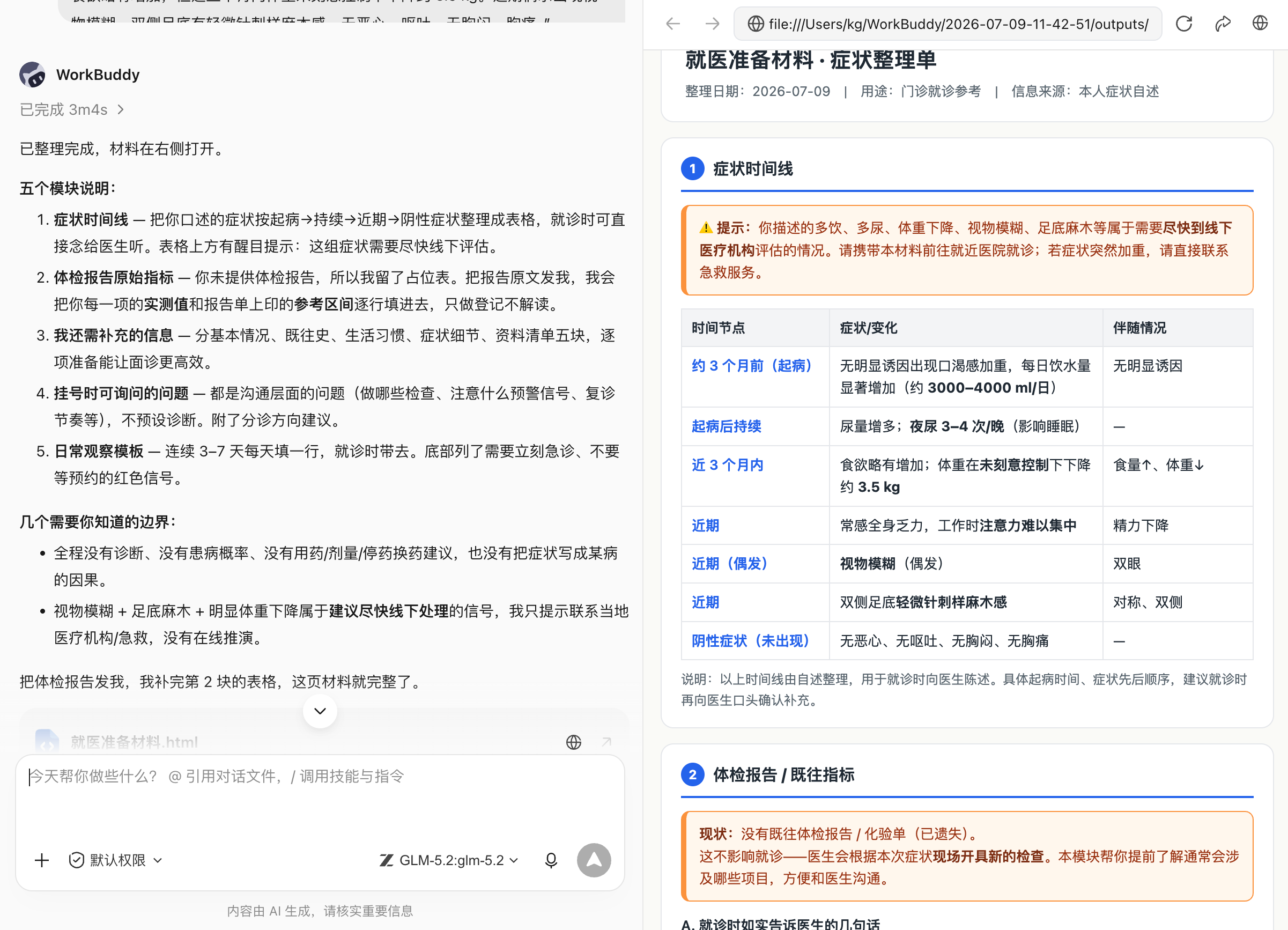
Turn the health report and symptom notes I provide into a one-page visit-prep sheet.
Output: symptom timeline, raw indicators vs reference ranges from the report,
info I still need to add, questions to ask at registration, a daily-observation template.

No definite diagnosis, no disease probabilities, no prescriptions, no dosing,
no stopping/switching advice; don't write correlation as causation.
If you spot info that may need timely in-person care, only prompt me
to contact a local medical institution or emergency service — don't keep reasoning online.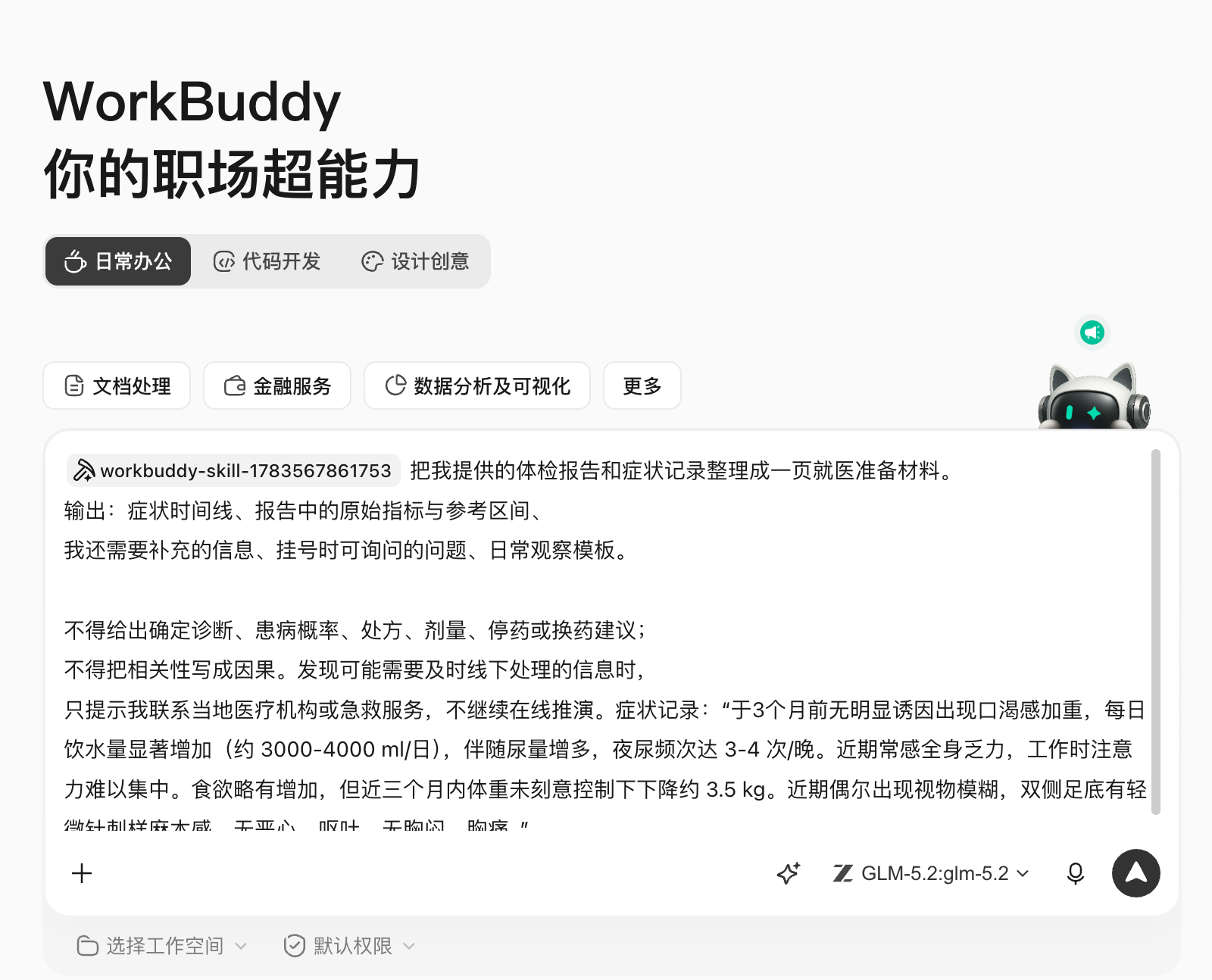
Above is a visit record I found online. When I sync this not-very-detailed record to WorkBuddy, it analyzes and generates visit-prep material.
Scene 4: Health Habits and Diet Plans, More Daily
Lower-risk health management suits WorkBuddy better: hydration, sleep, exercise, diet logging and follow-up reminders. Pick Skills like Nutrition & Health or Healthy Recipe Recommender, but still state allergies, disease, medication, pregnancy and professional limits.
From my confirmed diet preferences, allergies, budget and available cookware,
generate 5 days of dinner candidates and a shopping list. Each meal: main ingredients,
estimated time and swaps. Don't claim to treat disease or guarantee weight loss.
For diabetes, kidney disease, pregnancy or drug interactions, stop personalized advice
and list questions to confirm with a doctor or registered dietitian instead.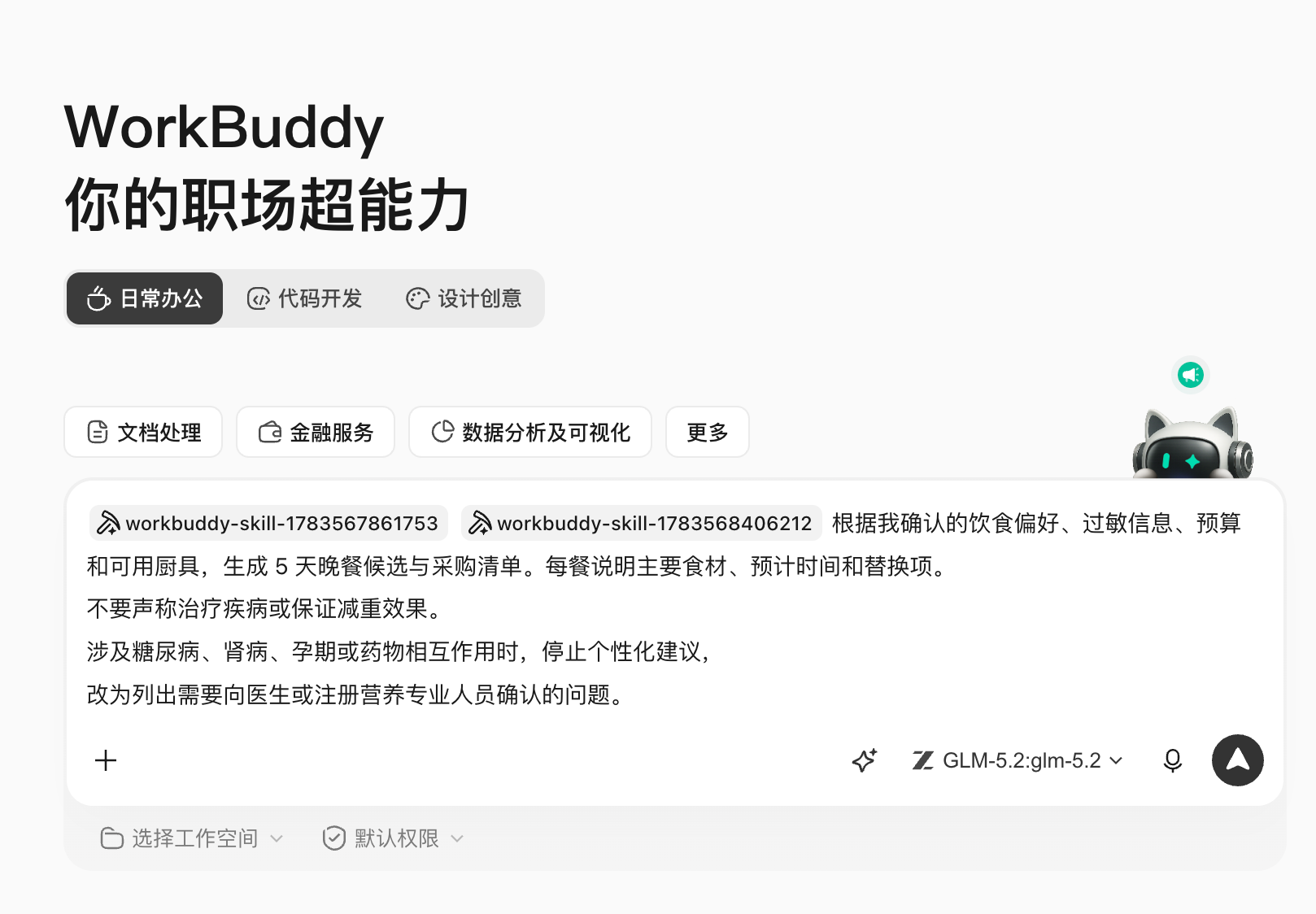
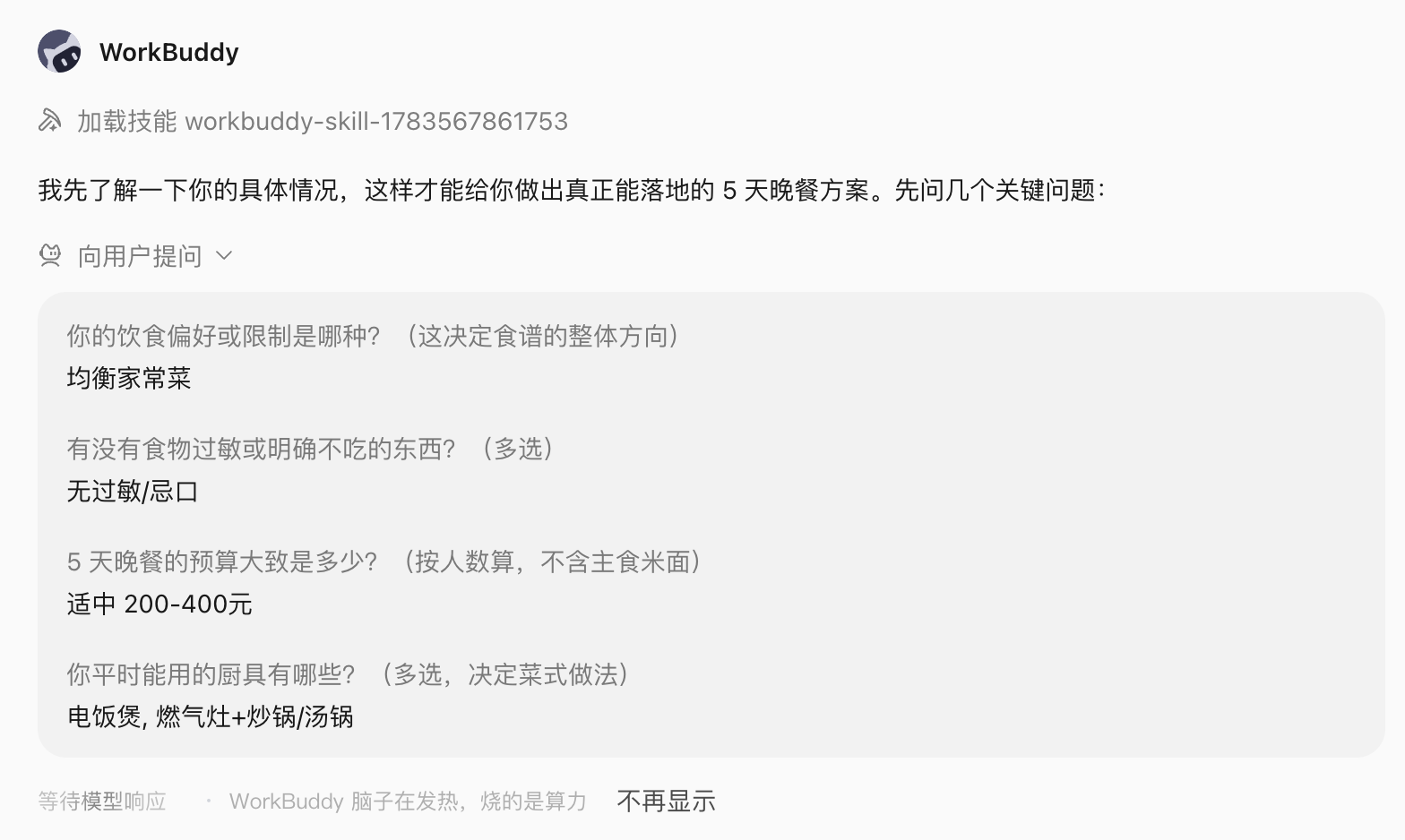
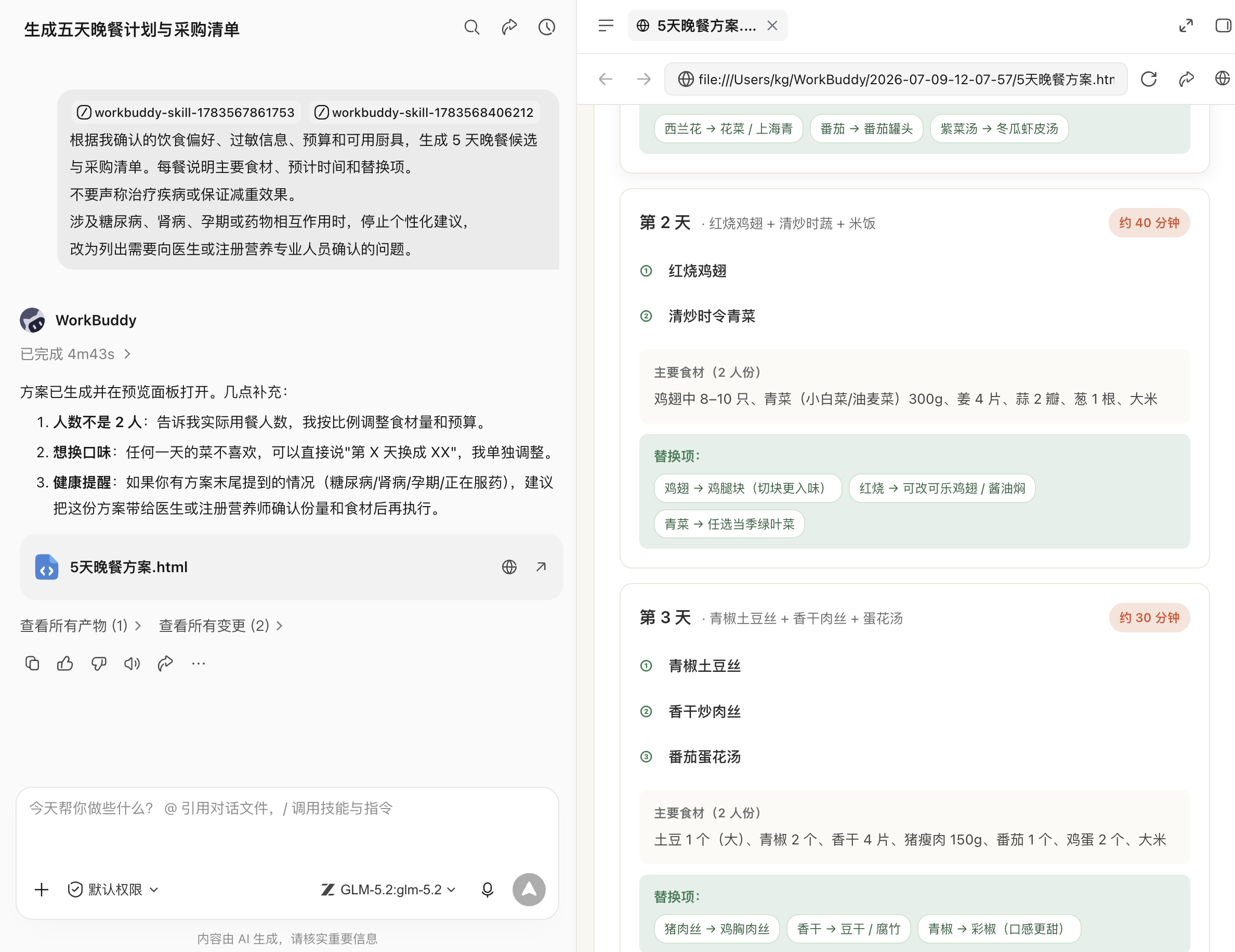
Likewise, during execution it carefully asks about my diet structure and the cookware currently in my kitchen, giving a dinner plan that's genuinely mine — not a precise-looking medical diet that doesn't actually fit me.
Scene 5: Fortune, Astrology and Divination — How to Be Fun Without Crossing Lines
Traditional culture and entertainment tests are many ordinary users' entry to Agents — useful for cultural experience, social interaction, writing inspiration and self-questioning.
But birth time, place and family info are personal; readings are easily written as definite prophecy; users may also act on them for medical, investment, hiring, marriage or career decisions.
A safer instruction:
Use a traditional-culture entertainment method to generate a Bazi cultural reading from info I voluntarily provide.
Start by clearly stating "for entertainment and cultural experience only; does not predict a definite future".
Separate chart calculation, traditional sayings and modern reflective questions; don't write traditional interpretation as fact.
No medical, investment, legal, marriage or career decision advice.
End by rewriting each conclusion into a verifiable self-question, and give at least one counterexample angle.
Don't keep birth time and place long-term; remind me to clear the input after the task.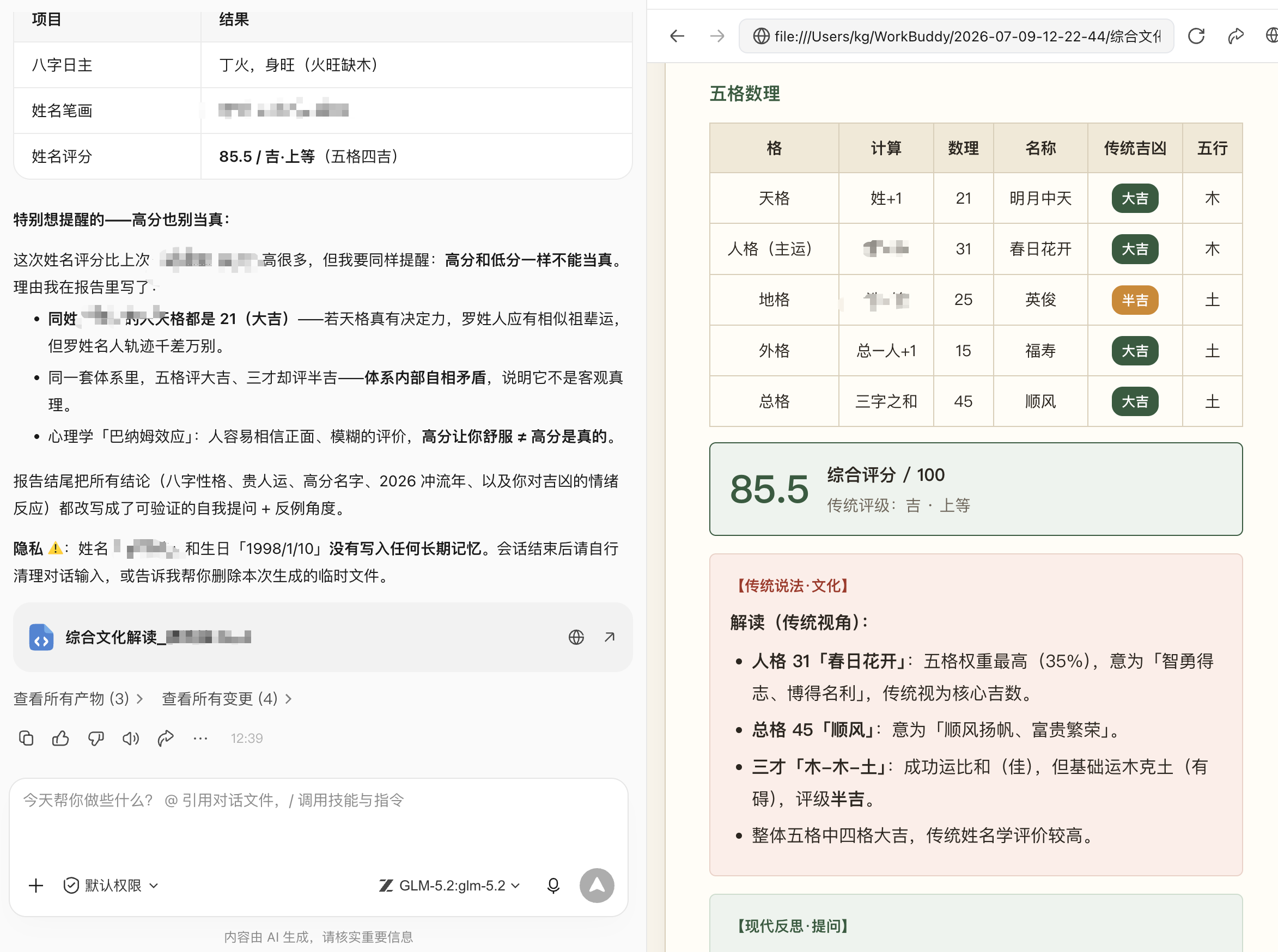
Scene 6: Outfits, Household Lists and Product Comparison
A life assistant has many low-risk but very practical scenes:
Using weather query and Daily Outfit Inspiration, input city, occasion, existing clothes and styles you don't like. The result should prefer existing wardrobe items — don't default to recommending purchases.
Make IDs, medicine, charging gear, kid items and pet arrangements into per-person lists with clear owners and status. Automation handles reminders — not whether a medicine suits a family member.
Let WorkBuddy build a table of params, price, after-sales, privacy and long-term cost; the human then checks official pages and the real contract. Sponsored content, affiliate links and merchant ratings must be marked separately — not mixed into the fact column.
Compare 3 robot vacuums, using only manufacturer sites, manuals and the quote I provide.
Table columns: cleaning structure, obstacle avoidance, consumables, privacy, warranty, price and unknowns.
Separate marketing claims from verifiable params; don't auto-recommend by sales rank.
Finally, give conditional advice based on "pet at home, 2cm thresholds, privacy-priority",
and don't place an order or accept service terms for me.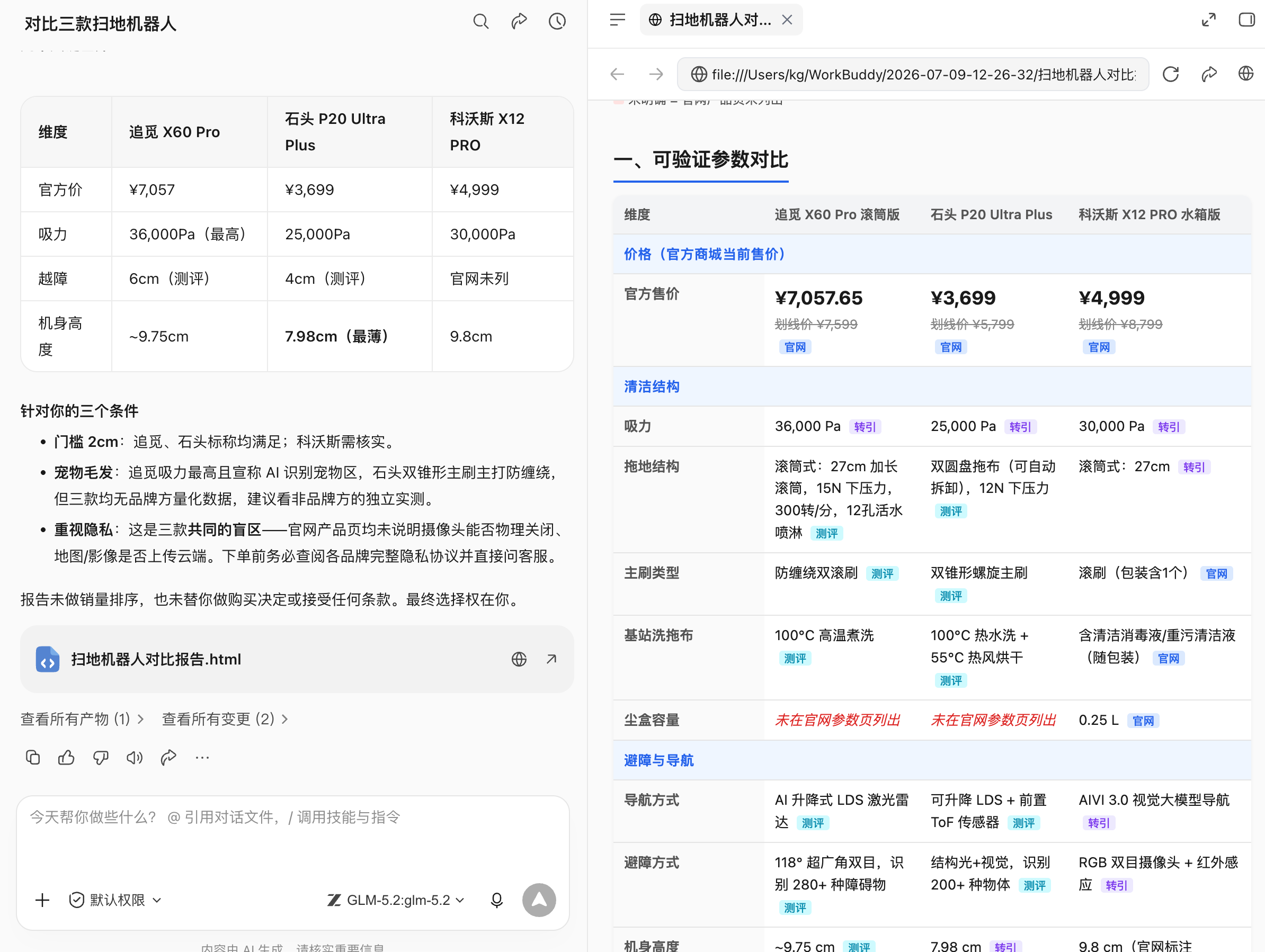
Scene 7: Mood Logging and Real-World Support
WorkBuddy can help log mood triggers, sleep, events and coping, and generate review questions or a summary for talking with a counselor. It won't impersonate a therapist or make the user rely only on the Agent.
Tidy this week's mood log by "event, thought, feeling, body reaction, action taken".
Only summarize repeating patterns; no diagnosis, no personality labels.
Generate 5 questions I can discuss with a trusted person or a professional.
If self-harm, harm to others, or immediate danger signals appear, stop normal review
and prompt me to contact local emergency services, a professional organization,
or a trusted person nearby right away.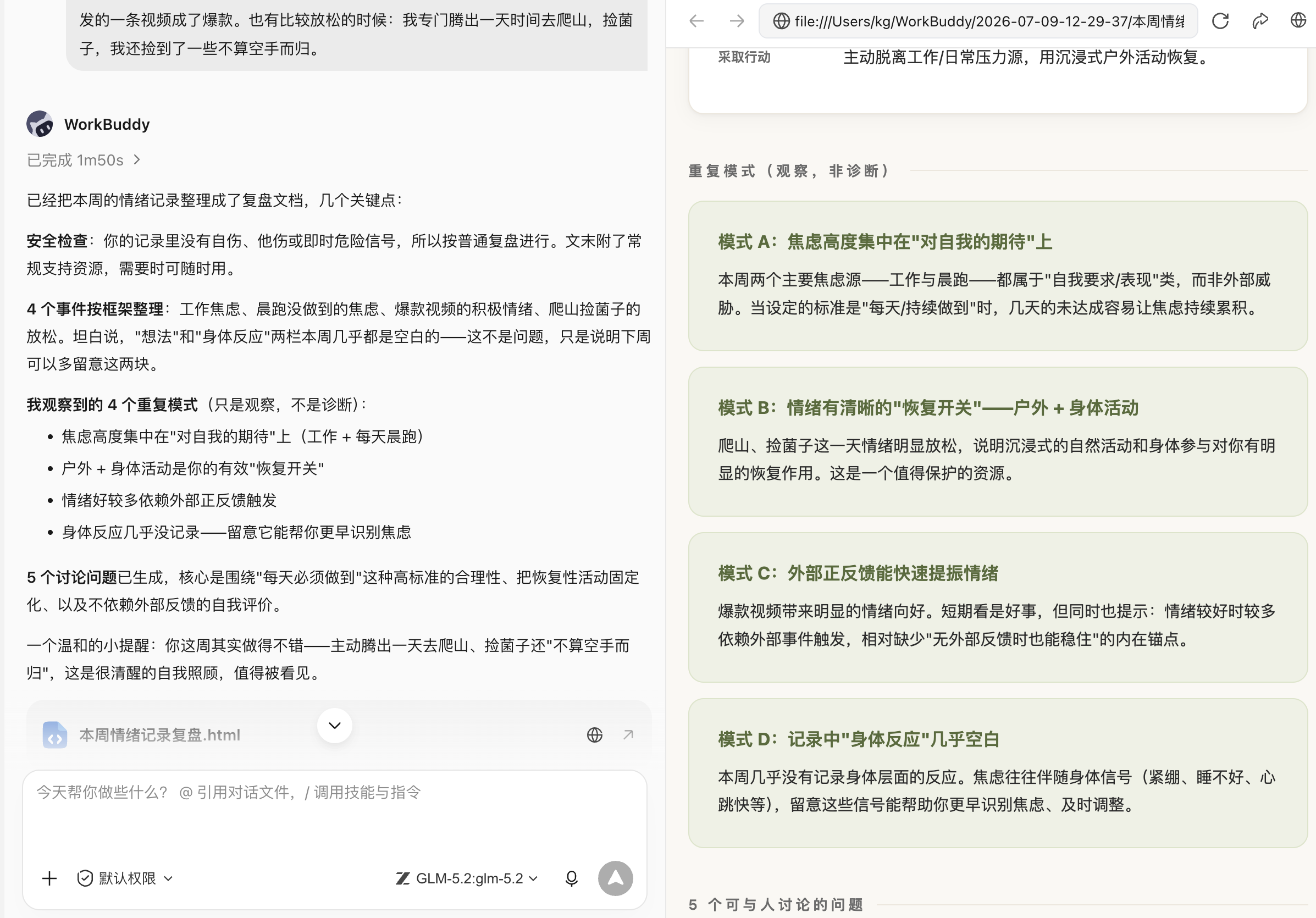
Four Checks Before Installing a Life Skill
- Real-time: where weather, price, stock, policy and opening hours come from, and the query date;
- Privacy: where birth info, location, health data and family material are sent, and whether it can process locally only;
- Action permissions: whether it logs in, books, pays, sends messages or edits the calendar, and whether it can pause before acting;
- Professional boundary: whether it writes entertainment as fact, health advice as diagnosis, or recommendation as guarantee.